

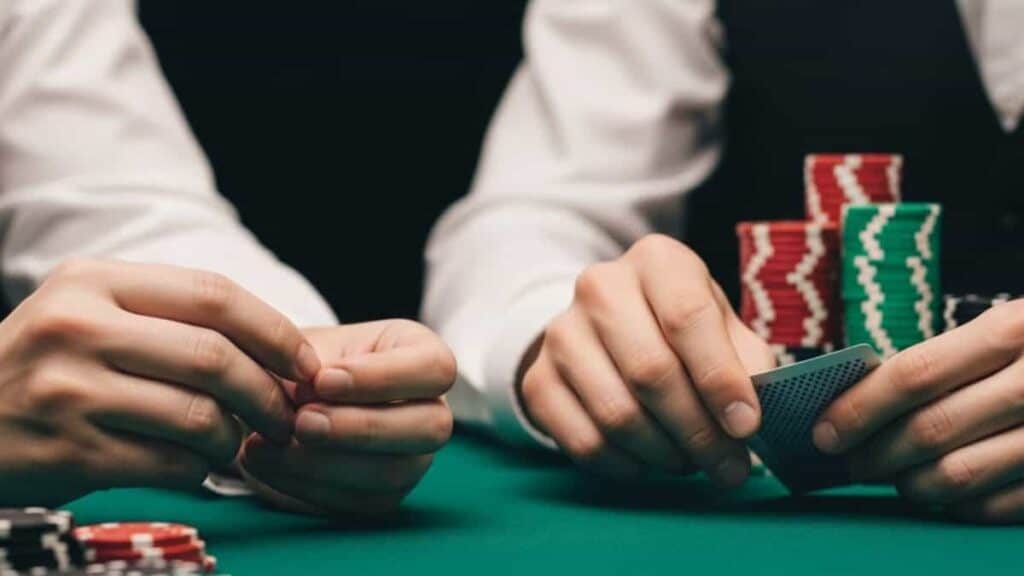
Psychology and Poker: Master the Mind Game Behind Every Hand
 Share
Share
Pop quiz: is poker a game of math and probabilities, or is it a test of psychological prowess? Are you playing the man or the cards?
The fact is, players who understand both — those who can read opponents accurately and manage their own emotions under pressure — are the ones who win consistently over time. Strong poker psychology tips won’t replace solid fundamentals, but they’ll sharpen every edge you already have.
Most poker players spend their study time on hand ranges, pot odds, and bet sizing. Almost none of them spend equal time on the mental side of the game. That’s a leak — and it’s one of the most profitable ones to fix.
The Opponent in the Mirror
Before you can read anyone else at the table, you have to reckon with yourself. This is harder than it sounds.
Poker players are capable of extraordinary self-deception. We don’t play too many hands; we just like to see flops. We didn’t make a bad raise; our opponent should have folded.
For every mistake made at the poker table, the poker mind finds an equal and opposite rationalization. And when all else fails, there’s always bad luck.
The honest version: most losing sessions contain mistakes that had nothing to do with the deck. Recognizing that is step one. Acting on it is step two.
Ego and Self-Delusion
Competition exposes everyone’s ego, but poker makes it particularly raw.
After all, it’s not just money on the line — it’s your intelligence, your judgment, your pride. Few things are as humbling as wrestling with the fact that an opponent completely outfoxed you in a hand.
Still, confidence is essential if you want to be a winning player. You can’t survive poker’s brutal variance without genuine self-belief.
But confidence that tips into arrogance becomes your biggest leak. It stops you from studying your own mistakes, makes you overestimate your reads, and worst of all, keeps you at tables you should have left hours ago.
The most valuable skill at the table isn’t any one strategic concept. It’s the willingness to analyze your own play with cold honesty. Losing hurts, but accepting that the loss was your fault hurts more.
It’s also the only thing that makes you better.
| Self-honesty is the silver bullet. You can read all the poker psychology books in the world, but nothing will make you a first-rate player except being honest with yourself about your leaks. |
Tilt: When Emotion Takes the Wheel
Tilt is the point where emotion takes over from logic. It’s one of the most expensive states in poker — and one of the hardest to catch yourself in, because the nature of tilt is that it actually distorts your judgment about whether you’re tilting.
It shows up in different ways. Sometimes it’s aggressive overbets, chasing losses, making moves that have no strategic logic behind them. Sometimes it’s the opposite; passive, defeated play after a big loss.
Either way, the decisions being made are driven by frustration rather than strategy.
The first step is identifying your personal tilt triggers. Could be a bad beat, an obnoxious opponent, or a hand you played badly. Everyone has different triggers, and knowing yours is the only way to catch the warning signs early.
The second step is the hardest: leave the game. Even briefly. Get up, do something else, and let the emotion pass. If you learn nothing else about your own psychology as a poker player, learning to walk away when you’re tilting will save you more money than any strategy adjustment.
Knowing Your Own Playing Style
Most players can identify a calling station or a maniac at the table within a few hands. Far fewer can accurately describe their own poker playing style.
Are you tight or loose? Do you bet and raise, or check and call? The honest answers — not the ones that reflect how you want to play, but how you actually play — matter more than most players realize.
A self-described aggressive player who folds under pressure, or a “disciplined” player who can’t resist speculative hands, is operating with a blind spot that costs money every session.
The same four-quadrant framework you’ll use to read your opponents applies to you. If you’re naturally tight-passive, you already know your default is to avoid confrontation. This means your bluffs are infrequent enough to be credible, but your value bets may be too small and too rare.
If you’re a natural LAG, you generate pressure and action, but you may be spewing in spots where patience would serve you better.
Neither style is wrong. Every style has exploitable edges and exploitable leaks. The goal isn’t to play like someone else, but to know yourself clearly enough to manage your tendencies deliberately, rather than being run by them without realizing it.
Using Psychology to Read the Players Around You
Once you have an honest handle on yourself, you can start working on everyone else. The psychology of reading opponents is part science, part art, but it all starts with a simple framework.
The Four Playing Styles
Most opponents can be roughly placed into one of four categories based on two spectrums: how many hands they play (tight vs. loose) and how they play them (passive vs. aggressive).
| Player Type | How They Play | How to Adjust |
|---|---|---|
| Tight-Passive (Rock) | Few hands, rarely bets or raises | Exploit passivity — steal pots with aggression |
| Loose-Passive (Calling Station) | Many hands, calls but doesn’t raise | Value bet relentlessly; never bluff |
| Tight-Aggressive (TAG) | Selective hands, bets and raises hard | Respect their aggression; pick spots carefully |
| Loose-Aggressive (LAG) | Many hands, bets and raises constantly | Don’t over-fold. Call down or 3-bet with strong hands in position. Let them bluff into you rather than fighting back out of position. |
Don’t treat these as rigid boxes. They’re starting points. Real players shift between styles depending on stack size, table dynamics, and how the session is going.
Your job is to identify where someone tends to sit on each spectrum — and adjust from there.
What Behavior Tells You
Aggressive players tend to project that aggression in how they carry themselves at the table — large buy-ins, loud presence, a need to dominate the room. The maniac archetype is easy to spot and notoriously difficult to play against.
Their primary weapon isn’t cards; it’s putting everyone else on tilt.
You’ll find passive players on the opposite end of the spectrum. Conflict-averse by nature, they’d rather not rock the boat. At the table, this often translates to calling when they should fold, and checking when they should bet.
They’re social, not aggressive — and that’s a disadvantage in a game built on extracting money from opponents.
Tight players tend to be deliberate and conservative, with neat chip stacks, measured speech, and methodical betting. Loose players are more impulsive, often chatty, sometimes sloppy with chips.
| Beware of stereotyping. Few players fit neatly into any category. Judgments based on age, gender, or appearance are a dangerous trap, and one your opponents will use against you if you fall into it. |
Adjusting Your Game to What You See
A psychological read is worthless if it doesn’t change how you play. The whole point is to translate what you’ve observed into strategic adjustments.
Adjustment Quick Reference
- Against a maniac: Tighten your range. Re-raise with your strong hands rather than flat-calling. Don’t try to out-bluff them; let them do the work. And above all, don’t let them put you on tilt. That’s exactly what they want.
- Against a passive player: Be more aggressive. They’re not going to punish you for it. Take the pots they’re willing to give up.
- Against a loose player: Value bet more and bluff much less. They’re going to call you. Make sure you want to be called.
- Against a tight player: Bluff more. Steal more pots. They’ll tell you when they have it.
The guiding principle is simple: for every flaw, there’s an optimal way to exploit it. Your job is to find it quickly and apply it consistently.
Table Psychology in Action: Bluffing, Table Image, and the Mind Game
Once you have a read on an opponent and an honest assessment of yourself, you can start playing the game within the game.
Levels of Thinking
Real poker psychology operates through levels of thinking. Level 1 is purely self-focused: what do I have? Level 2 adds the opponent: what do they have? Level 3 asks what your opponent thinks you have. Level 4 asks what your opponent thinks you think they have, and so on.
Most recreational players operate at level 1. Solid players operate at levels 2 and 3. The highest-level games — where the real mind games live — require level 4 thinking and above.
Getting there requires two things: an accurate read on your opponent, and a clear understanding of how your opponent is reading you.
Your Table Image
Your table image is how everyone else at the table perceives you. It’s shaped by every hand you’ve played, every bet you’ve made, and every time you’ve shown cards. And it determines how opponents will respond to your actions.
If you’ve been playing tight for two hours, a large bet from you will get more respect — and more folds. If you’ve been aggressive and loose, the same bet is more likely to get called. Neither is inherently better. The point is to know what your image is, and to use it.
The mistake most players make is assuming their opponents see them the way they see themselves. But they don’t have all the information you have; if you’ve had a run of good cards, they’re not thinking you’re a tight player betting and raising for value. They see you as a maniac.
Get in the habit of watching yourself the way an opponent would.
The Bluff: Poker’s Ultimate Mind Game
Before running any bluff, consider position, stack sizes, and board texture. These determine whether your story is believable.
A bluff on a board that connects with your range, from a position where your bet makes sense, against a player with enough chips to feel the pain of calling wrong, is a real bluff. Everything else is a gamble.
The psychological layer sits on top of that foundation. A player who just took a bad beat is protecting a short stack size and a bruised ego, so they’ll often fold more.
A player who’s been running hot and playing confidently is harder to move. Bluffs travel toward perceived weakness, which is why reads and timing matter. But they only work if the hand itself makes sense.
Know your own table image too. If you’ve been playing tight and straightforward, your bets carry weight. If you’ve been caught bluffing twice in an hour, everyone’s likely just waiting their turn to look you up.
Keep track of your image, and adjust accordingly.
Where Poker Psychology Meets the Math
Psychology isn’t a substitute for solid poker math. The two work together. However, a player who understands the numbers but ignores the human side of the game is leaving real money on the table.
Master the math, and you’ll make correct decisions in a vacuum. Add poker psychology, and you’ll know when to deviate, when to exploit, and when the numbers are only half the story. The players who consistently beat their competition aren’t just calculating pot odds — they’re reading the room.
That’s the combination that’s genuinely hard to beat: a player who both calculates odds and reads people accurately.
Related Lessons
| Lesson | Why it matters |
|---|---|
| The Levels of Thinking in Poker | How deep does your opponent think? And how deep do you? |
| Understanding Poker Tells | Physical and verbal cues that reveal what players are holding. |
| Poker Players and Table Image | How others see you at the table — and how to use it. |
| Understanding Tilt | What causes tilt and how to recognize it in yourself. |
| Avoiding and Dealing with Tilt | Practical steps for getting off tilt and staying off it. |