

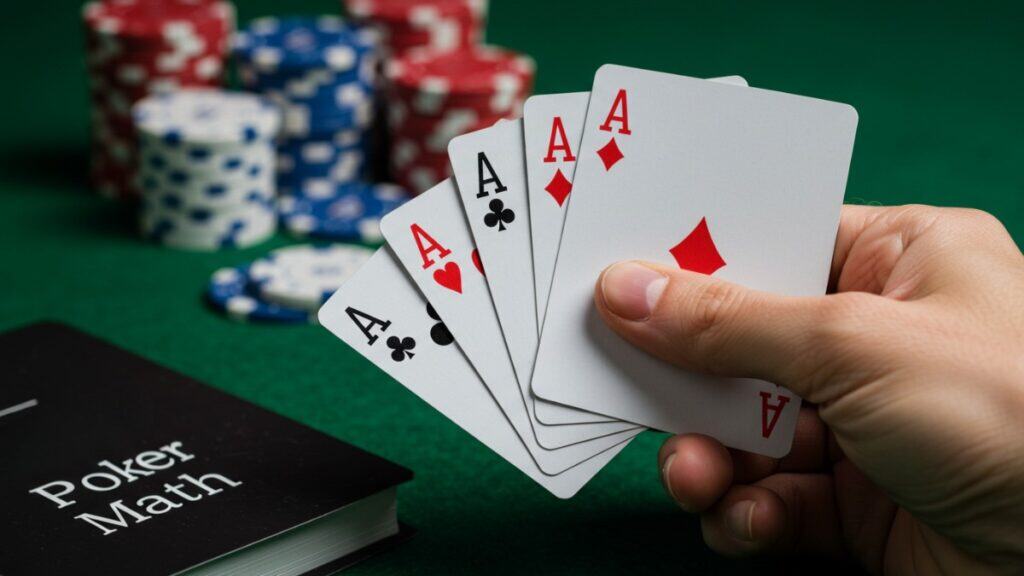
Poker Math & Probability: The Complete Guide
 Share
Share
Every decision at a poker table has a mathematically correct answer. You may not be able to calculate it in real time, but once you start understanding the underlying math, your instincts will start pointing in the right direction more consistently.
This guide covers poker probability from the ground up: how probabilities are expressed, pre-flop hand frequencies, post-flop improvement odds, outs, pot odds, implied odds, expected value, and variance.
Each section builds on the last, ending with a single worked hand that ties all of it together. Let’s get started.
What Is Probability?
Poker runs on incomplete information. You never know exactly what your opponent holds, but you can calculate how likely different outcomes are and make decisions that are correct over time.
This section covers how probability works and why card removal matters to every calculation you make.
Probability Basics
Probability measures how often an event occurs across a large number of trials. If you flip a coin, heads will come up half the time. That is a probability of 0.5 (also expressed as 50% or 1-to-1 odds).
In poker, probability is expressed three ways:
- Percentage — a flush draw hits by the river about 35% of the time
- Fraction — that same draw is 35/100
- Odds — expressed as against-to-for, roughly 1.86-to-1 against
All three formats describe the same thing. You’ll hear odds discussed at the table most often, as this is the easiest way to calculate pot odds. This guide uses percentages throughout.
Cards Have Memory
A standard deck has 52 unique cards. Every card dealt removes one possibility from what remains. This is what poker players mean when they say cards have memory.
The odds of receiving an Ace as your first card are 4 in 52 — about 7.7%. If that first card is the Ace of Hearts, only three Aces remain in 51 unseen cards. The probability of pairing it immediately drops to 3/51, or 5.9%.
Every card revealed — hole cards, flop, turn, river — shifts the probabilities of every remaining outcome. Accurate poker math always accounts for cards already removed from the deck.
Pre-Flop Probabilities
Before the flop, your two hole cards determine your starting equity. Knowing how often certain hand types appear — and how they perform against common opponent holdings — is the foundation of sound pre-flop decision-making.
Probability of Key Hand Types
There are 1,326 possible two-card starting hands in Texas Hold’em. Premium hands are rarer than most players assume.
Pocket Aces: the probability of being dealt any specific Ace as your first card is 4/52. Conditional on that, receiving another Ace is 3/51. Combined:
| (4/52) × (3/51) = 12/2,652 ≈ 0.45% → once every 221 hands |
Any pocket pair is more common because there are 13 possible pairs. Overall pocket pair frequency: 13/221 ≈ 5.9%, or roughly once every 17 hands.
| Starting Hand | Frequency |
|---|---|
| Pocket Aces (or any specific pair) | 0.45% (1 in 221) |
| Any pocket pair | 5.88% (1 in 17) |
| Ace-King offsuit | 1.21% |
| Ace-King suited | 0.30% |
| Suited connectors | 3.92% |
| Connected cards (10 or higher) | 4.83% |
The gap between Ace-King suited (0.30%) and suited connectors (3.92%) matters: players remember the upside of premium structure more than how rarely it actually appears.
Hand vs. Hand Matchups
A strong starting hand is an equity edge, not a guarantee. Pocket Aces win roughly 82% against King-Queen suited before the flop — which means the weaker hand still wins about once every five attempts.
| Matchup | Favorite | Win % | Underdog Win % |
|---|---|---|---|
| Pocket Aces vs Pocket Kings | Pocket Aces | ~82% | ~18% |
| Pocket Kings vs Ace-King Suited | Pocket Kings | ~70% | ~30% |
| Ace-King vs Pocket Queens | Pocket Queens | ~57% | ~43% |
| Ace-King Suited vs Ace-King Offsuit | AKs | ~53% | ~47% |
These are equity edges, not guaranteed outcomes. Over thousands of repetitions those small percentages create a real gap between solid pre-flop strategy and expensive pre-flop leaks.
Post-Flop Probabilities: Improving Your Hand
Once the flop is revealed, the question shifts from starting hand frequency to improvement odds. Two numbers anchor most post-flop decisions.
A pocket pair flops a set 11.8% of the time. That means set-mining misses 88.2% of flops — and the play only works when effective stacks are deep enough to recover the pre-flop investment on the times you do connect.
A flopped flush draw gets there by the river about 35.0% of the time. An open-ended straight draw completes about 31.5%, while a gutshot hits roughly 16.5%.
Those gaps explain why overplaying suited cards is such a common poker mistake and why weak straight draws become expensive leaks when the price is wrong.
| Draw Type | Flop→Turn | Turn→River | Flop→River |
|---|---|---|---|
| Flush draw (9 outs) | 19.1% | 19.6% | 35.0% |
| Open-ended straight (8) | 17.0% | 17.4% | 31.5% |
| Gutshot straight (4) | 8.5% | 8.7% | 16.5% |
| Set draw — pocket pair (2) | 4.3% | 4.3% | 8.4% |
| Two overcards (6) | 12.8% | 13.0% | 24.1% |
Note: These figures assume no cards are counterfeited and no opponent holds blocking cards. The Outs section below covers when these numbers need to be adjusted.
Outs
This section turns probability into an in-game shortcut: count your outs, estimate your equity, compare that equity to what the pot is offering.
What Is an Out?
An out is any unseen card that improves your hand to the likely winner.
Example: you hold A♠️ 10♠️on a board of K♠️7♠️ 2♥️. Any spade gives you a flush.
There are 13 spades in the deck; four are already visible. That leaves nine remaining spades — nine outs.
Common Outs by Hand Type
| Draw Type | Outs |
|---|---|
| Flush draw | 9 |
| Open-ended straight draw | 8 |
| Two overcards | 6 |
| Gutshot straight draw | 4 |
| Set draw (pocket pair) | 2 |
| Outs | Flop→Turn | Turn→River | Flop→River (Rule of 4) |
|---|---|---|---|
| 2 | 4.3% | 4.3% | ~8% |
| 4 | 8.5% | 8.7% | ~16% |
| 6 | 12.8% | 13.0% | ~24% |
| 8 | 17.0% | 17.4% | ~32% |
| 9 | 19.1% | 19.6% | ~36% |
| 12 | 25.5% | 26.1% | ~48% |
| 15 | 31.9% | 32.6% | ~60% |
The Rule of Four and Two
At the flop, multiply your outs by four to estimate your chance of improving by the river. At the turn, multiply by two for your river chance.
| 9 outs on the flop: 9 × 4 = 36% (exact: 35.0%) 9 outs on the turn: 9 × 2 = 18% (exact: 19.6%) |
The rule of four slightly overstates equity with more outs — 15 outs gives 60% by the formula versus about 54% precisely. For most in-game decisions, the approximation is close enough.
Counterfeited Outs
Not every out is a clean winner. Some cards complete your draw while simultaneously improving an opponent to a better hand.
Example: you hold A♥️ 3♥️ on a board of K♥️ 9♥️ 4♠️. You have nine flush outs. But if an opponent holds K♣️ K♠️ — a set of Kings — then the 4♥️ ️is a counterfeited out. It would give you a flush, but it would also give your opponent a full house.
| Counterfeited outs Before counting all your outs, ask whether any of those cards also improve your opponent. Paired boards, sets, and two-pair holdings are the most common sources of counterfeit outs. Counting them inflates your equity estimate and leads to calls that are not actually profitable. |
Pot Odds
Pot odds translate probability into a yes/no call decision. They show what percentage of equity you need to break even on a call.
Definition and How to Calculate
Express the call as a share of the final pot after the call is made.
| Pot = $90 | Call = $10 | Final pot = $100 Required equity = $10 / $100 = 10% |
If your equity exceeds 10%, the call is profitable over time. If it falls below, then making a laydown is smart.
Comparing Pot Odds to Your Equity
A nine-out flush draw has about 35% equity by the river. Calling $10 to win a final pot of $100 requires only 10% equity. The call is clearly profitable because 35% is well above the 10% threshold.
If the same flush draw faced a call of $70 into a $90 pot — a final pot of $160, requiring 43.8% equity — the call would be a long-term loser. The draw does not have enough equity to justify the price.
Are You Getting the Right Price?
| Draw Type | Outs | Equity (by river) | Min equity required |
|---|---|---|---|
| Flush draw | 9 | 35.0% | Must be offered > 65% pot odds |
| Open-ended straight | 8 | 31.5% | Must be offered > 68.5% pot odds |
| Gutshot | 4 | 16.5% | Must be offered > 83.5% pot odds |
| Set draw | 2 | 8.4% | Must be offered > 91.6% pot odds |
Fold Equity
Pot odds measure raw equity. Fold equity is the additional value created when a bet or raise can win the pot outright.
If a $50 semi-bluff into a $100 pot makes a better hand fold more than one time in four, the play is profitable before your draw equity is even counted.
This is why aggressive semi-bluffs — betting a flush draw rather than calling — often outperform passive calls in the right spots. The draw gives you one way to win; the aggression gives you another.
Implied Odds
Pot odds only price the current decision. Implied odds account for money that can still enter the pot on later streets.
Set-mining is the clearest example. Calling a raise with a small pair fails a strict pot-odds test most of the time — the pair flops a set only 11.8% of the time. But when it does hit, the set is disguised and the opponent will often pay off a large bet or even a stack. Those future winnings justify calls that pot odds alone do not.
The same logic applies to suited connectors. A 7♠️6♠️ on a dry board rarely wins in a showdown — but the hands it makes are hard to read and dangerous when they connect.
Implied odds are only valid when three conditions are met:
- Effective stacks are deep enough that future streets can carry meaningful money
- The opponent is likely to pay off when the draw completes
- Your hand is sufficiently disguised that the opponent will not put you on the draw
| Reverse implied odds The mirror of implied odds. A second-best made hand — top pair with a weak kicker, for example — can cost far more on later streets than the immediate call suggests. If you complete your draw but your opponent can beat it, those future bets work against you. |
Expected Value
Expected value (EV) is the average result of a decision repeated over many trials. A play is +EV when it wins money in the long run and −EV when it loses, regardless of what happens on any individual hand.
Results do not tell you whether you played correctly. A −EV call can win. A +EV call can miss. The math describes what happens across thousands of repetitions, not on the next card.
Worked example:
| Call $10 into a $100 final pot with 35% equity EV = ($100 × 0.35) − ($10 × 0.65)EV = $35.00 − $6.50 = +$28.50 |
The call is profitable by $28.50 on average, even though the draw still misses 65% of the time.
Variance and Bad Beats
Variance is the normal spread between long-run expectation and short-term results. Bad beats are not anomalies — they are the mathematical consequence of hands with 20% or 30% equity winning their fair share of the time.
The correct response to a bad beat is to evaluate the decision, not the outcome. If the money went in correctly, the play was correct. A missed flush draw that was a profitable call remains a profitable call in hindsight.
Tilt is where variance becomes expensive. Frustration pushes players away from mathematically sound decisions — calling too wide, bluffing too often, or folding to pressure when the price is right. Protecting your decision-making after a bad beat is worth more than any individual pot.
Putting It Together
Here is how all of the above applies to a single decision.
| The hand You hold J♥️ T♥️. Board: A♥️ 8♥️ 3♣️. Your opponent bets $40 into a $60 pot. |
Step 1 — Count your outs. Nine flush outs. You also have a backdoor straight possibility, but ignore that for now. Nine clean outs assuming no counterfeits.
Step 2 — Estimate equity. Rule of four with two cards to come: 9 × 4 = 36%. Exact figure from the table: 35.0%.
Step 3 — Calculate pot odds. Pot is $60. Opponent bets $40. Final pot if you call: $140. Required equity: $40 / $140 = 28.6%.
Step 4 — Compare. Your equity (35%) exceeds the required equity (28.6%). Calling is profitable on pot odds alone.
Step 5 — Consider fold equity and implied odds. If raising might fold out the opponent, that adds EV beyond the draw equity. If you call and hit, will the opponent pay a river bet? Deep stacks and a call-heavy opponent make the implied odds stronger. Shallow stacks or a tricky opponent reduce them.
| Call: +EV on raw pot odds (35% > 28.6%) Raise: better if fold equity is meaningful Fold: only correct if outs are counterfeited or stack depth removes implied odds |
Now that you know how to think through the math and probabilities of a hand, all that’s left to do is practice at the best online poker sites.
Probability of Each Poker Hand
These are five-card deal probabilities — calculated from the 2,598,960 possible five-card combinations in a standard deck. Texas Hold’em frequencies differ slightly because players use the best five cards from seven, but the ranking order is identical.
| Poker Hand | Combinations | Probability | Frequency |
|---|---|---|---|
| Royal Flush | 4 | 0.000154% | 1 in 649,740 |
| Straight Flush | 36 | 0.00139% | 1 in 72,193 |
| Four of a Kind | 624 | 0.0240% | 1 in 4,165 |
| Full House | 3,744 | 0.1441% | 1 in 694 |
| Flush | 5,108 | 0.1965% | 1 in 509 |
| Straight | 10,200 | 0.3925% | 1 in 255 |
| Three of a Kind | 54,912 | 2.1128% | 1 in 47 |
| Two Pair | 123,552 | 4.7539% | 1 in 21 |
| One Pair | 1,098,240 | 42.2569% | 1 in 2.37 |
| High Card | 1,302,540 | 50.1177% | 1 in 2 |
| How rare is a royal flush? Four royal flush combinations exist — one per suit. In a five-card deal, the probability is 0.000154%, or once every 649,740 hands. In Texas Hold’em, where you use any five cards from seven, a royal flush appears roughly once every 30,940 hands. In practice, many players go their entire careers without making one. |
One pair appears 42.26% of the time. Most poker profit comes from pricing common spots correctly, not from chasing rare hands.
| Related Lessons | |
|---|---|
| Variance in Poker | Why results and correct decisions are not the same thing. |
| Understanding Expected Value | How EV thinking applies across every street. |
| Poker Drawing Odds & Outs | Complete outs tables for every common draw type. |
