

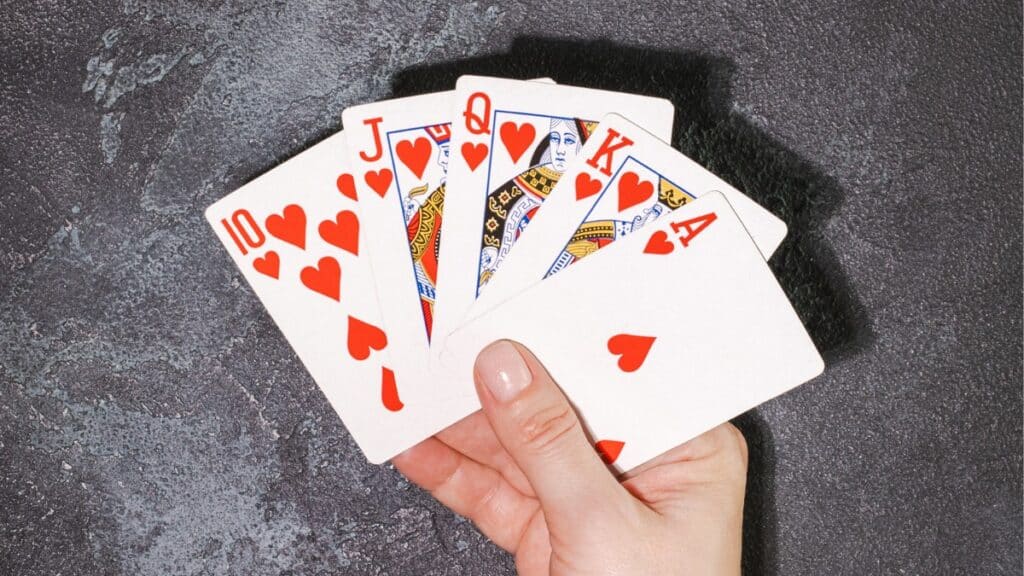
How to Play Five-Card Draw Poker: Rules and Gameplay Explained
 Share
Share
Before Texas Hold’em took over cardrooms and home games, five-card draw was the game most people meant when they said poker.
You get five private cards, one chance to swap some of them out, and two rounds of betting to figure out where you stand. If you want to learn how to play five-card draw, this guide covers the rules, the structure, and how real hands play out from deal to showdown.
The Setup
Before the cards are dealt, the table needs a simple structure in place. Five-card draw poker is usually played with a small group, a forced bet to build the pot and a standard five-card deal.
Unlike community card games, every card you receive is private, which changes how players gather information and make decisions.

Players and the Table
Five-card draw typically works best with two to six players. The game technically allows for more, but as the table grows, the deck runs out of cards during the draw phase.
Most home games settle into four to six players — enough action while still leaving plenty of cards in the deck.
Deck: Standard 52 cards. No jokers.
Players take turns acting as the dealer. In casual games, the dealer position rotates clockwise after each hand. It matters because it determines where betting begins and how the action moves around the table.
Antes and Blinds
Five-card draw games need forced bets to create an opening pot. Without them, players could fold every weak hand and wait indefinitely. Two structures are commonly used.
Antes — The traditional version. Before the cards are dealt, every player places a small amount into the pot. In a five-player game with a $1 ante, the pot starts at $5 before anyone sees a card. The first betting round happens immediately after players look at their hands.
Blinds — Some modern games use a blind structure like Texas Hold’em. The player to the dealer’s left posts a small blind; the next player posts a big blind. Home games often prefer antes because they keep rules simple and involve every player equally in each hand.
The Deal
Once forced bets are posted, each player receives five cards face down, one at a time, moving clockwise until everyone has a complete hand.
All five cards are private. No cards are exposed, and there are no community cards. Every decision is based solely on your own hand and your opponents’ behavior.
Because no shared cards appear, players must rely heavily on betting patterns and draw decisions to read their opponents. If someone draws one card, three cards, or none at all, that choice becomes a key piece of information.
After everyone receives their five cards, the game moves to the first betting round.
The Betting Rounds
Unlike Texas Hold’em or Omaha, which can have up to four betting rounds, five-card draw poker has two. The first happens after the initial deal; the second happens after the draw.
Between those two moments, players decide how strong their hand is and how much risk they want to take.
We’ll follow a sample hand through both rounds. Imagine a five-player game using antes. After the deal, you look down at:
| A♥ A♣ 9◆ 5♠ 2♥ |
You hold a pair of Aces.
First Betting Round
In ante games, the first player to the dealer’s left starts the action. In blind games, it’s the first player to the left of the big blind. Action moves clockwise.
Each player has the standard options:
- Check — if no bet has been made
- Bet — to start the action
- Call — match an existing bet
- Raise — increase the bet
- Fold — give up the hand
The round continues until every remaining player has matched the highest bet or folded.
Back to the example: you’re in middle position with your pair of Aces. The first player checks; the next bets.
Folding Aces here would be too cautious, so you call. Two others call as well. The first betting round ends with four players still in the pot.
Now the game moves to the draw.
The Draw
Starting with the first active player to the dealer’s left, each player declares how many cards they want to discard. Discards go face down; the dealer replaces them from the deck.
Most games allow exchanges of zero to three cards. Some house rules allow four cards if your remaining card is an Ace — though this is rarely optimal and basically exposes your hand.
Draw sizes carry meaning. Here’s what each typically signals:
| Draw Size | Most Likely Holding |
|---|---|
| Draw 3 cards | Pair — keeping two, discarding three |
| Draw 2 cards | Three of a kind, or a pair with a strong kicker kept |
| Draw 1 card | Two pair, or four to a straight/flush |
| Stand pat (0) | Made hand — straight, flush, or better (or a bluff) |
Back to the example: you discard the 9, 5, and 2, keeping your Aces. You draw three new cards and get the Ace of spades, the King of diamonds, and the 7 of clubs, giving you:
| A♥ A♣ A♠ K◆ 7♣ |
Your hand is now three Aces. Around the table, one opponent draws one card; another draws three; the player who bet pre-draw stands pat.
Those draw sizes tell a story before a single card is turned over. Once every player has drawn, the game moves to the second betting round.
Second Betting Round
Same structure as the first — check, bet, call, raise, or fold. This round often produces the biggest decisions of the hand because players now hold their final five cards.
The first player checks. The player who stood pat bets into the pot.
Standing pat and betting is a confidence signal. That player could have a straight, a flush, or possibly two pair they’re representing as stronger. You’re holding three Aces — folding isn’t realistic. The question is whether to call or raise.
You raise. One player folds. Another calls. The original bettor calls the raise. Betting is complete. The remaining players move to the showdown.
The Showdown
After the second betting round, any players still in the hand reveal their cards. The player who made the final bet shows first. If the last round ended with checks, the first player to the dealer’s left shows first. The best five-card hand wins.
The player who stood pat turns over:
| K♣ K♥ 10♠ 10◆ 4♥ |
Two pair — Kings and Tens. That player either made a mistake not discarding the 4♥ to chase a full house, or they stood pat to disguise the strength of their hand.
You reveal:
| A♥ A♣ A♠ K◆ 7♣ |
Three Aces beats two pair. You win the pot.
Unlike community card games, five-card draw has no shared board to read. Each player simply compares their final five cards. If two players share the same hand ranking, the highest kicker decides the winner. Identical hands split the pot.
If you need a refresher on how hands rank against each other, you can learn how poker hands are ranked.
| Are Aces high or low? In most five-card draw games, the Ace plays both ways — high (above a King) or low in an A-2-3-4-5 straight, which is called the wheel. |
Once the pot is awarded, the dealer button moves one seat clockwise and the next hand begins.
Five-Card Draw Strategy: How to Think About Your Hand
Once you understand the structure, the real challenge becomes interpreting what other players are doing. With no community cards, nearly all information at the table comes from betting behavior and how many cards each player draws.
Five-card draw strategy starts with paying attention to those signals — and thinking about how your own decisions look from the outside.
What Your Draw Tells Your Opponents
The number of cards you exchange sends a clear message. Experienced players watch the draw closely because it often reveals the general shape of a hand.
Drawing three cards usually means a player started with a pair. Keep a pair of 7s, discard the other three, and hope to improve to two pair, trips, or a full house.
Drawing two cards signals a stronger starting position — perhaps three of a kind, or a pair with a strong kicker the player wants to keep. If someone holds a pair of threes and an Ace, they’re hoping to make trips or Aces up. An unimproved pair of threes is unlikely to win at showdown.
Drawing one card is where things start to look dangerous. The player might have two pair and be trying to improve to a full house, or four to a straight or flush. It’s also a prime bluffing spot: draw one card, then come out betting, and opponents may assume you completed your draw.
Standing pat usually represents a made hand — straight, flush, or better. Some players stand pat as a bluff, betting that the table will assume strength and fold. A player who raises pre-draw and then takes no cards sends a strong message regardless of what they actually hold.
Starting Hand Strength
Not every five-card hand is worth playing past the first betting round. One of the most common mistakes beginners make is calling bets with weak holdings that rarely improve enough to win.
A solid baseline is a pair. If you hold:
| A♥ A♣ 9◆ 5♠ 2♥ |
You have a clear plan — keep the pair, draw three. Higher pairs are better because they start ahead of more opponents.
Medium pairs (9s–10s) are playable in most games, especially if first-round betting stays small.
Small pairs (2s–3s) become questionable against aggressive action. Folding often saves money. However, a small pair with an Ace or King kicker gains value — you can make strong two-pair hands.
Hands without a pair are usually folds unless they contain four to a straight or flush. For example:
| 10♥ 8♥ 5♥ 3♥ 2♣ |
Four to a flush. Discard the 2♣ and draw one card.
What to avoid: completely unconnected hands like:
| K♠ 10◆ 7♣ 5♥ 2◆ |
No pair, no straight draw, no flush draw. Even after the draw, hands like this rarely become strong enough to win.
Position and Betting Patterns
Position matters in five-card draw just as it does in other poker games. Players who act later gain more information because they see how everyone else behaves first.
Late position is especially valuable here — you see both the betting decisions and how many cards each opponent draws before you act. Early position requires more caution because you don’t yet know how the rest of the table will respond.
Betting patterns help reveal what players are likely holding:
A player who bets before the draw, takes one card, and raises after the draw — that sequence strongly suggests a powerful made hand. Two pair improving to a full house, or a completed straight.
A player who checks pre-draw, draws three cards, and then makes a large bet — that could mean a dramatic improvement, but it’s also one of the cleaner bluff lines in the game.
Over time, watching how players bet and how many cards they draw gives you a clearer read on their tendencies. Some only stand pat with the nuts. Others use it as a bluff when they sense weakness. Understanding those patterns is what separates beginners from experienced five-card draw players.
Five-Card Draw Rules: The Quick Reference
A fast reminder of how the game works. These points cover the essential five-card draw rules used in most home games and casual tables.
| Rule | How It Works |
|---|---|
| Player count | Two to six players at the table |
| Forced bets | Antes from every player, or small blind and big blind |
| The deal | Five cards face down, one at a time — all cards private |
| First betting round | Check, bet, call, raise, or fold after cards are dealt |
| The draw | Discard and replace up to three cards (house rules may vary) |
| Second betting round | Same options as the first round |
| Showdown | Remaining players reveal cards after the final betting round |
| Winning the pot | Best five-card hand wins by standard poker rankings |
These core rules are the same foundation used in most versions of the game. Home games sometimes have small variations, but the structure above covers standard five-card draw.
| Related Lessons | |
|---|---|
| Poker Hand Rankings | Know exactly which hands beat which before you sit down. |
| How to Get Better at Poker | A no-nonsense guide to improving your game, regardless of which game you choose to play. |
| How to Play 2-to-7 Triple Draw | Three draws and a lowball ranking system — the draw game taken further. |
| How to Play Five-Card Stud | The closest relative to five-card draw, with exposed cards instead. |
| How to Play Badugi | A four-card draw game with its own unique hand rankings. |