

David Sklansky, Author of The Theory of Poker, Dead at 78
Poker legend and author David Sklansky died on March 23 in Las Vegas following heart failure. He was 78.
The announcement arrived with the weight carried when the person was genuinely irreplaceable. Sklansky was not just a great player who happened to write books, but a thinker who changed how the game was understood before most of the people playing it today were even born.
Sklansky didn’t just contribute to poker’s intellectual foundation. For a generation of serious players, he was the foundation.
What He Walked Into
To understand what Sklansky built, it helps to understand what the game looked like before him.
When Sklansky began playing professionally in the 1970s, poker’s culture was rooted in instinct, feel, and table wisdom that didn’t transfer to the page easily. The players who dominated live games came from a tradition that treated the game as psychological warfare.
Strategy literature barely existed. The idea that poker could be analyzed the same way a mathematician might analyze a statistical problem was, to most serious players, somewhere between novel and absurd.
Sklansky entered that environment with pencil-and-paper answers to questions the card rooms were still trying to settle with proposition bets. His nickname, “The Mathematician,” wasn’t an honorific invented after the fact. It reflected what he actually provided: a way of resolving poker disputes with calculation rather than argument.
That reputation opened doors. Doyle Brunson, whose own thinking was grounded in feel and reads rather than formulas, recognized something useful and recruited Sklansky to write the Seven-Card Stud Hi-Lo Split chapter of his landmark 1979 book Super/System precisely because the math was something Brunson’s own voice couldn’t supply.
The Book
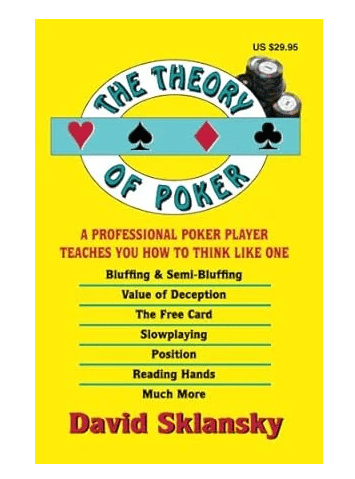
The Theory of Poker, first published in 1978, is the part of Sklansky’s poker legacy that matters most. Not because it was Sklansky’s only significant work — it wasn’t, across a career that eventually produced 18 books — but because it introduced a vocabulary and a framework that the game has never discarded.
The centerpiece is the “Fundamental Theorem of Poker,” which Sklansky stated plainly:
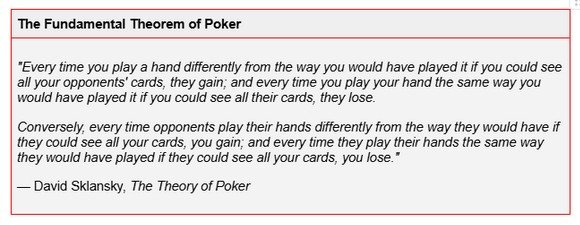
Written out like that, it reads almost like common sense. The depth is in the application.
The theorem reframes every decision at the poker table as a question about information and error — not about courage, reads, or feel. It says that poker, fundamentally, is the ongoing attempt to minimize your own mistakes while creating conditions for your opponents to make theirs. Everything else exists in service of that single underlying logic.
The book also introduced semi-bluffs, showing how combining fold equity with drawing equity can produce profitable aggression in marginal spots. His early writing on gap theory explained that players need stronger hands to call raises than to make them, offering practical guidelines for positional strategy. These weren’t abstract ideas. They were working tools, and serious players adopted them immediately.
The Theory of Poker introduced a vocabulary that now feels so native to how poker is discussed that it’s easy to forget someone had to put it on paper first.
A Theory Tested by the Solver Era
The arrival of solver software in the 2010s created a genuine reckoning for poker’s existing theoretical framework. Concepts that had been accepted for decades were shown to be incomplete or outright wrong under computational analysis. Some of what Sklansky wrote didn’t survive intact.
But the Fundamental Theorem proved more durable than many of the specific heuristics built on top of it. Modern poker is based around a Game Theory Optimal approach — a balanced strategy which is theoretically unexploitable.
The goal of GTO play is to perform as close as possible to how you would play with perfect information about your opponent’s range. That is, in essence, a computational formalization of what Sklansky had described in plain language decades earlier.
His concepts influenced countless coaching programs and continue to appear in solver discussions today.
What’s more interesting, and more honest, is that Sklansky himself was never fully sold on pure GTO as a practical playing strategy. GTO, in Sklansky’s framing, is a defensive posture — correct against the best opponents, but unnecessarily conservative against everyone else.
The Fundamental Theorem was always about finding and exploiting errors, and a strategy designed to be unexploitable leaves money on the table when your opponents are making mistakes. He acknowledged that knowing GTO is valuable but argued that it should be the floor, not the ceiling, for how seriously you study the game.
That tension between theoretical rigor and practical exploitation runs through nearly everything Sklansky wrote. It’s why his work remained relevant as the game evolved rather than becoming a historical curiosity.
The Playing Record
Sklansky’s tournament résumé was real, if not extensive. He won two WSOP events in 1982 — the Mixed Doubles Limit Seven-Card Stud alongside Dani Kelly, and the $1,000 Limit 5-Card Draw High — both earning gold watches that year rather than bracelets.
He returned in 1983 to take down the $1,000 Limit Omaha event, this time earning a bracelet. His career-best live result came much later: a third-place finish in the 2006 WPT $10,000 Borgata Poker Open, worth $419,040. Lifetime tournament earnings totaled a reported $1,410,664.
He appeared on Poker Superstars on Fox Sports Net during the 2000s boom, reaching an audience far beyond the card rooms where his reputation had been built. His playing activity slowed significantly in his final years — two small cashes in 2024 marked his first recorded tournament activity since 2017.
The playing record matters less, ultimately, than what surrounds it. Sklansky was not primarily a tournament player, and his influence was never measured in cashes.
The Catalog and Its Reach
Eighteen books across a career is a significant output in any field. In poker writing, it’s almost without parallel.
The catalog ranges from Hold’em Poker and Tournament Poker for Advanced Players to Sklansky Talks Blackjack and broader works on gambling in general. At the height of the poker boom, he achieved something of a publishing benchmark: three titles simultaneously ranked in Amazon’s top 100 — which he claimed made him one of only two authors to ever accomplish the feat (the other being J.K. Rowling of Harry Potter fame).
His final book, Small Stakes No-Limit Hold’em: Help Them Give You Their Money, was released in December 2023 with longtime collaborator Mason Malmuth. The book was entirely in keeping with the core argument he’d been making since 1978: that understanding where opponents deviate from correct play, and adjusting to exploit those deviations, is where the real money lives.
It was not a nostalgia project. It was a working poker book, written at 76, aimed at players who needed practical guidance more than theoretical purity.
The Forum That Changed How Poker Was Learned

If the books established the theoretical framework, Two Plus Two Publishing — the company Sklansky co-founded with Mason Malmuth — built the infrastructure that distributed it.
The Two Plus Two forums, which grew alongside the publishing operation, became the dominant online destination for serious poker study during the boom years of the 2000s and remained influential well into the following decade.
At their peak they were where the best online players in the world argued strategy, stress-tested concepts, and developed ideas that eventually found their way into training sites, coaching programs, and the solver-era discourse that followed.
The forums were not a passive library. They were a working environment, and the culture of rigorous, math-grounded analysis that defined them traced directly back to the intellectual standards Sklansky had been advocating since the 1970s.
That combination — books that established the vocabulary and a forum that put it into daily practice for hundreds of thousands of players — created a self-reinforcing ecosystem for serious poker education that had no real precedent and no obvious successor. The training sites and Discord servers that came after were built by people who learned to think about poker in exactly the environment Sklansky and Malmuth created.
It is difficult to overstate how much of the modern serious player’s baseline assumptions about the game — that it can be studied, that theory matters, that results are less important than decision quality — were shaped by that ecosystem.
What Remains
Sklansky’s theoretical vocabulary — terms like expected value, pot odds, fold equity, range advantage — was not always the natural language of poker. Someone had to establish that poker was the kind of game that had a natural language in the first place.
Sklansky did that, at a time when there was nothing but the math itself to point to as proof.
The proof came later, in the form of a generation of players who learned from what he wrote, and a solver era that validated — and in some cases corrected — the framework he had laid down. That’s a reasonable measure of how important the work was: it was substantial enough that its limits were worth arguing about.
David Sklansky is survived by his books. The game he helped build is still being played.
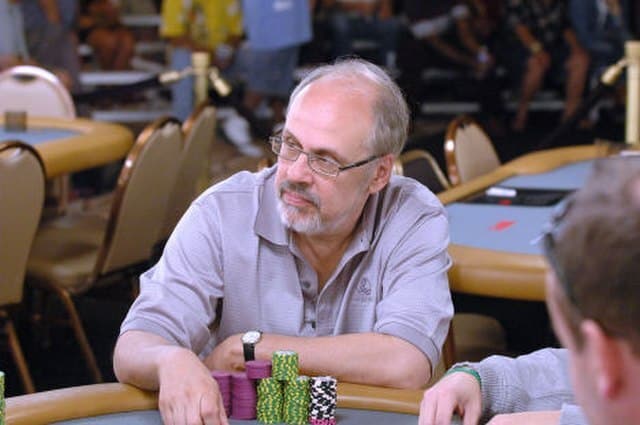
Photo: flipchip / LasVegasVegas.com (CC BY-SA 3.0)