

Poker Terms Explained: Poker Meanings 2026
 Share
Share
As a lifelong poker enthusiast, I’m always intrigued by how poker terminology has seamlessly made its way into everyday conversation — especially in business settings.
Phrases like “hold your cards close to your chest,” “call that bluff,” “I’d rather be lucky than good,” and “poker face” are now part of our daily lexicon. While many people recognize a few of these expressions, beginner players may be surprised by the depth of poker’s vocabulary.
In fact, if you don’t know what various poker terms mean, you could find yourself hopelessly lost in the middle of a hand, or miss out on valuable information at the table.
Those mistakes cost money. Lots of money, if you make them often enough.
That’s why I’ve put together this list of poker terminology. These are the terms that actually matter at the table — the ones that will keep you from looking (or worse, acting) like a fish at the worst possible time.
Quick Reference: The Most Common Poker Terms
These are the phrases you absolutely must know. If you’re not familiar with any of these, then I’d recommend bookmarking this list for quick lookups.
| Term | Quick Definition |
|---|---|
| All-in | Betting all your remaining chips at once |
| Bad Beat | When a strong hand is beaten by a lucky underdog that catches a perfect (and statistically unlikely) card |
| Bluff | Betting with a hand that can’t win at showdown in the hopes of making opponents fold |
| Calling Station | A player who calls too frequently (do not bluff calling stations) |
| Donkey / Fish | A weak, unskilled player |
| Flop | The first three community cards dealt in Texas Hold ‘Em or Omaha |
| GTO | Short for “Game Theory Optimal,” this refers to making plays based on a mathematically balanced strategy |
| Gutshot | An inside straight draw with only 4 outs (e.g, JT on a A K 3 board) |
| Nuts | The best possible hand given the board |
| Pocket Rockets | A pair of aces in the hole |
| Pot Odds | Ratio of pot size to the cost of calling; for example, if it costs $10 to call and there’s $100 in the pot, your pot odds are 10:1 |
| River | The fifth and final community card dealt in Texas Hold ‘Em or Omaha (also called “5th street”) |
| Runner-Runner | When a player must hit perfect cards on both the turn and river to win |
| Set | Three of a kind using a pocket pair + one board card |
| Tilt | Playing recklessly due to frustration or anger |
| Turn | The fourth community card dealt in Texas Hold ‘Em or Omaha (also called “4th street”) |
The Basic Structure of a Hand
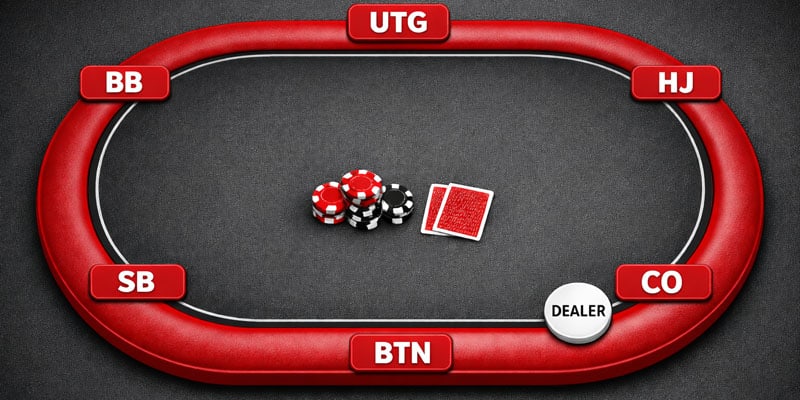
Before a single card is dealt, poker already has rules about who bets, how much, and in what order. These structural terms — positions, forced bets, and streets — are the skeleton of every hand you’ll ever play.
The terms below define exactly who sits where and what that means for how a hand unfolds.
| Term | Definition |
|---|---|
| Ante | A small forced bet all players must post before the deal. Common in stud games and later tournament levels, in addition to the blinds. |
| Blinds | Mandatory bets by the first two players left of the dealer button — small blind and big blind. They seed the pot before any cards are dealt. |
| Button (BTN) | Represents the dealer position, marked by a small disc. The button acts last in every post-flop betting round, making it the most powerful seat at the table. |
| Under the Gun | The first player to act pre-flop, immediately left of the big blind. Acting before everyone else is a significant disadvantage. |
| Cutoff (CO) | One seat to the right of the button. The second-best position — you act second-to-last on every post-flop street. |
| Hijack (HJ) | Two seats right of the button. A middle position from which blind-stealing becomes viable against tight opponents. |
| Runout | The remaining community cards still to be dealt. “How did the runout go?” means, “What came on the turn and river?” |
Starting Hands & Holdings
The cards dealt face-down to each player — the hole cards — are the foundation of every hand. How players describe and categorize these cards is the first layer of poker vocabulary most beginners encounter.
| Term | Definition |
|---|---|
| Pocket Rockets | A pair of Aces as your hole cards — the best possible starting hand in hold’em. |
| Big Slick | Nickname for Ace-King. Other common nicknames include “Anna Kournikova” and “Walking Back to Houston.” |
| Pocket Pair | When your two hole cards share the same rank, e.g., two Jacks. |
| Suited | Hole cards of the same suit, e.g., A♥ K♥. Suited hands carry added flush potential compared to their offsuit equivalents. |
| Offsuit | Hole cards of different suits. Noted with an “o”: AKo means Ace-King offsuit. |
| Suited Connectors | Consecutive-ranked cards of the same suit, like 8♦ 9♦. These hands can make both straights and flushes. |
| Broadways | Cards ranked Ten through Ace. Broadway hands are premium high-card holdings that connect well with strong boards. |
| Wheel | The lowest possible straight: A-2-3-4-5. Also called a bicycle or a bike. The best possible hand in hi/lo games, as it can be used to win both halves of the pot. |
Betting Actions & Mechanics
Betting is the language of poker. Every bet, raise, check, or fold communicates something about your hand — or is designed to make your opponent believe something that isn’t true.
One critical practical note: in a live poker setting, betting actions are binding. If you say “raise,” you’re raising — even if you haven’t decided on an amount yet. Moving chips forward without a verbal declaration, then reaching back for more, is an illegal string bet and will be disallowed by the dealer.
When in doubt, announce your action verbally before touching your chips. Getting these mechanics wrong at the table has real consequences, so learn them before you sit down.
| Term | Definition |
|---|---|
| All-in | Betting all your remaining chips at once. In games like No-Limit Hold ‘Em, you can go all-in at any time. |
| Bluff | Betting or raising with a hand that’s unlikely to win at showdown, hoping opponents fold so you take the pot. |
| Check | Declining to bet when you’re not facing an existing bet, passing the action to the next player. |
| Check-Raise | Checking when it’s your turn, then raising after another player bets. A powerful deceptive move that signals strength. |
| Limp | Just calling the big blind pre-flop rather than raising. Generally considered passive play. |
| 3-Bet | A re-raise of an initial raise. If one player opens and another raises, a third player re-raising is making a 3-bet. |
| 4-Bet | A re-raise of a 3-bet. These escalating pre-flop exchanges significantly narrow both players’ ranges. |
| C-Bet | Continuation bet— a flop bet by the pre-flop aggressor, continuing their story of strength into the next street. |
| Donk Bet | A bet made by an out-of-position player into the pre-flop aggressor on the flop. A legitimate GTO line in some spots, but often a mistake at lower levels. |
| Probe Bet | A bet on the turn or river after the previous street’s aggressor checked back — used to take control of the hand. |
| Isolate | Raising to force other players out, with the goal of playing heads-up against a single target opponent. |
| Straddle | A voluntary bet (typically double the big blind) made by UTG before any cards are dealt. The straddler will then act last preflop. Straddles effectively double the stakes for the given hand. |
| String Bet | Putting out chips to call, then reaching back for more chips to raise without declaring intent first. An illegal move; your raise will not be allowed. Always announce “raise” verbally before moving chips. |
Hand Types & Made Hands
Knowing the difference between a set and trips, or understanding why a cooler isn’t a mistake, matters both strategically and socially at the table.
Players who can’t articulate their holdings clearly often give away more information than they realize, and players who can’t read the board accurately frequently miss when they’ve made a strong hand — or when their strong hand is already beaten.
| Term | Definition |
|---|---|
| Nuts | The best possible hand given the current board. The “mortal nuts” is a hand that can’t possibly be beaten, regardless of what other cards are dealt. |
| Monster | A very strong hand that is almost certainly the winner — strong enough that you’re focused on maximizing value rather than worrying about losing. |
| Set | Three of a kind made by holding a pocket pair and hitting one matching card on the board. E.g., holding 7-7 and flopping a 7. |
| Trips | Three of a kind where two matching cards are on the board and you hold one in your hand. Unlike a set, two players can hold the same trips simultaneously. Trips are also much less disguised than a set. |
| Quads | Four of a kind. E.g., “he had quad Kings.” One of the strongest possible hands in hold’em. |
| Boat | A full house — three of a kind plus a pair. E.g., Kings full of Tens. |
| Top Pair | Pairing the highest card on the board with one of your hole cards. |
| Overpair | A pocket pair higher than any card on the board. Holding Pocket Aces on a K-8-3 board is an overpair. |
| Cooler | Two very strong hands colliding where the loser had little choice but to commit their chips. Losing a cooler is bad luck, not a mistake. |
Drawing Hands & Outs
A drawing hand is one that isn’t strong yet but has the potential to become one with the right cards to come. Understanding draws — and more importantly, counting your outs accurately — is the bridge between playing poker on instinct and playing it with math on your side.
| Term | Definition |
|---|---|
| Out | A card that improves your hand, usually to a winner. Holding two hearts with two on the flop gives you nine outs to a flush. |
| Gutshot | An inside straight draw with only four outs. If you hold Q J on a 9-8-3 board, you’d need one of the four Tens to complete the straight. |
| Open-Ended Straight Draw | A straight draw completable at either end — eight outs. Holding 9 8 on a 7-6-2 board gives you an open-ended straight draw that can be completed by a 5 or a Ten. |
| Double Belly Buster | Two inside straight draws offering the same eight outs as an open-ender but far more deceptively. For example, if you hold J 9 on K-T-7 board, you can make a straight with either a Q or an 8. |
| Flush Draw | Four cards of the same suit, needing one more to complete the flush. This gives you nine outs, assuming all your cards are live. |
| Combo Draw | Multiple draws simultaneously — e.g., a flush draw plus a straight draw. Can have 15+ outs and actually be a favorite over made hands. |
| Runner-Runner | A hand completed by hitting needed cards on both the turn and the river. Also called “back door.” A long shot: most runner-runner draws are under 5% to complete. |
| Drawing Dead | A draw where no card in the deck can win the hand, as your opponent’s hand already beats every possible card you could hit. |
Pot Odds, Math & Equity
You don’t need to be a mathematician. You need to understand a handful of concepts — pot odds, implied odds, equity, expected value — and be able to apply rough versions of them in real time.
The players who can do that, even imperfectly, have a structural edge over those who play purely by feel.
| Term | Definition |
|---|---|
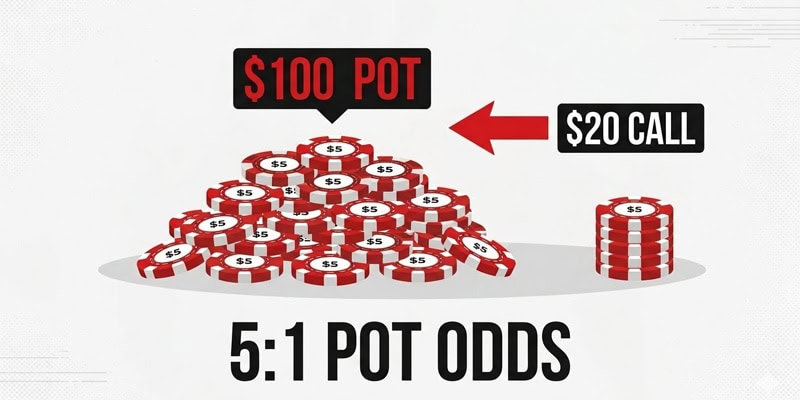
| Pot Odds | The ratio of the pot size to the cost of calling. A $100 pot requiring a $20 call gives you 5-to-1 odds. If your hand is likely to win more than 1 in 6 times, calling is correct. |
| Implied Odds | An extension of pot odds that accounts for money you expect to win on future streets if you hit your draw. Strong implied odds can justify calls that raw pot odds alone cannot. |
| Equity | Your share of the pot based on your probability of winning at any given moment. For example, pocket Aces are roughly a 4-1 favorite over any other hand pre-flop, giving them around 80% equity. |
| Equity Realization | How much of your theoretical equity you actually capture in practice. Position, hand playability, and opponent tendencies all affect it. |
| Expected Value (EV) | The average profit or loss of a decision made repeatedly over time. +EV decisions make money long-term; -EV decisions lose money regardless of short-term results. |
| SPR | Stack-to-Pot Ratio — the ratio of the effective stack size to the pot. Low SPR = simpler committed decisions; high SPR = deeper, more complex post-flop play. |
| Rule of 4 and 2 | A quick mental estimate. Multiply your outs by 4 on the flop (two cards to come) or by 2 on the turn (one card to come) to get your approximate equity percentage. |
| Fold Equity | The added value of a bet or raise that comes from the chance your opponent folds. All-in shoves gain value both from getting your opponents to fold and from winning at showdown. |
Modern Strategy: GTO & Solver Concepts
GTO — Game Theory Optimal — and the solver-based approach to studying poker became the dominant framework for thinking about the game around 2015–2016. The vocabulary that came with it has fully replaced the older generation of poker language at the serious end of the game.
| Term | Definition |
|---|---|
| GTO | Game Theory Optimal — a strategy that is mathematically unexploitable regardless of what your opponent does. In theory, a perfect GTO player cannot be profited from in the long run. |
| Solver | Software that calculates GTO solutions for specific poker scenarios. Modern professionals use solvers to study away from the table. |
| Exploitative Play | Deliberately deviating from GTO to target a specific opponent’s weakness. Against someone who folds too much, you bluff more. Against a calling station, you value bet more thinly. |
| Range | The complete set of hands a player could hold in a given situation. Thinking in ranges — not specific hands — is the foundation of modern poker strategy. |
| Range Advantage | When one player’s overall range is stronger on a given board. The player with range advantage typically controls the betting and can apply more pressure. |
| Polarized Range | A range consisting of very strong hands and bluffs, with little in between. Polarized strategies use large bet sizes. |
| Merged Range | A range spanning the full spectrum of hand strength. Associated with smaller bet sizes since medium-strength hands are included. |
| Blocker | A card in your hand that reduces the number of strong combinations your opponent can hold. Holding the A♠ on a board with multiple spades “blocks” the nut flush and the nut flush draw. |
| Combo | A specific combination of two hole cards. Ace-King has 16 possible combos (4 × 4 suits); pocket Aces has only 6. |
| Mixed Strategy | Playing a hand multiple ways at certain frequencies — e.g., betting 60% and checking 40% — to remain unpredictable. Solvers frequently output mixed strategies. |
| Indifference | A GTO concept where your strategy makes your opponent’s decisions breakeven between options. Correct bluffing frequency makes opponents indifferent between calling and folding. |
| Node | A decision point in a game tree. Solvers compute optimal play at every node across millions of possible scenarios. |
Tournament Poker Terms
Tournament poker is a different game from cash poker, and not just because you can’t reload your stack. The introduction of pay jumps creates a layer of strategic complexity that cash games don’t have — the value of your chips is no longer directly proportional to their face value.
| Term | Definition |
|---|---|
| ICM | Independent Chip Model — assigns real dollar values to tournament chips based on stack sizes and payout structure. Chip EV and money EV diverge significantly near the bubble and final table. |
| Bubble | The point just before the money. Players eliminated on the bubble win nothing despite potentially hours of play. ICM pressure is at its highest here. |
| Chip EV vs. $EV | Chip EV ignores payout structure; $EV accounts for it. Correct tournament decisions maximize $EV, not chips — especially near the bubble or final table. |
| Push/Fold | Short-stack strategy: move all-in or fold pre-flop, eliminating post-flop complexity when your stack is too small to play normally. Push/fold charts map optimal shoving ranges. |
| Final Table | The last table remaining, typically 9 players. Strategy is heavily ICM-influenced since every elimination changes pay jumps significantly. |
| Rebuy | In rebuy tournaments, players can purchase additional chips after busting, up to a defined point in the event. |
Player Types & Table Dynamics
Poker players have been categorizing each other since the first card game was dealt. Identifying the type of player you’re up against is one of the fastest ways to adjust your strategy — and the vocabulary to do it has been part of the game for decades.
| Term | Definition |
|---|---|
| Donkey / Fish | A weak, unskilled player who makes fundamental strategic errors. Also called a pigeon or a sucker. Every poker economy runs on their action. |
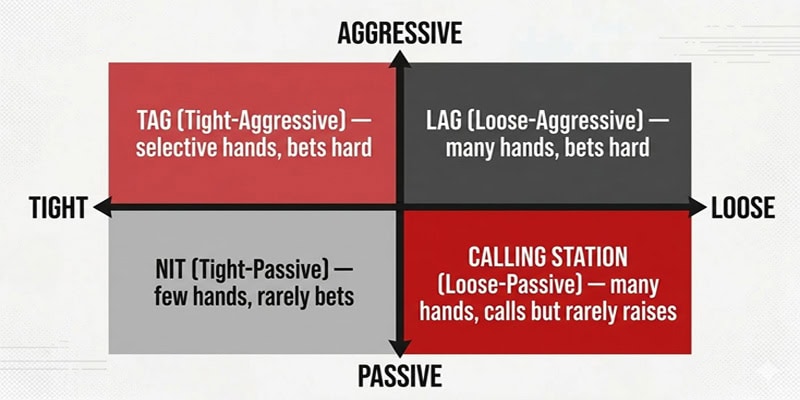
| Calling Station | A player who calls far too often and without correct pot odds. |
| Nit | An extremely tight player who only plays premium hands. Predictable and easy to bluff — but hard to get value from when they do play back. |
| Maniac | A hyper-aggressive player who bets and raises constantly, often regardless of hand strength. |
| LAG | Loose-Aggressive. Plays many hands and bets aggressively. When executed with skill, one of the most profitable styles in poker. |
| TAG | Tight-Aggressive. Plays few hands but plays them strongly. The standard “winning baseline” style recommended for beginners. |
| Reg | Short for regular. A competent, experienced player who plays frequently. Most regs play TAG or LAG and are breakeven-to-winning. |
| Recreational | A player who plays for fun rather than profit. Finding tables with recreational players is the single biggest edge a serious player can have. |
Miscellaneous Terms
Not every poker term fits neatly into a strategic category. These are the terms you’ll encounter at the table that describe the texture of the game — the emotional swings, the etiquette, the variance, and the occasional horror story.
| Term | Definition |
|---|---|
| Bad Beat | A strong hand beaten by a weaker hand that hit a lucky draw. Every poker player has at least one bad beat story. Most have dozens. |
| Bad Beat Jackpot | A casino promotion triggered when a very strong hand is beaten by an even stronger one. The losing hand, winning hand, and often the whole table receive a payout. |
| Sandbag | Hiding a strong hand by checking or calling early to extract more money on later streets. Effective against aggressive opponents who will bet into you. |
| Cards Speak | The best hand is determined by turning cards face-up with no declaration — the values of the cards speak for themselves. |
| Heads-Up | Playing one-on-one against a single opponent. Requires significant strategic adjustment versus full-ring play; ranges widen considerably. |
| Muck | To fold and discard your hand face-down. The pile of discarded cards is also called the muck. |
| Rags | Worthless low cards that connect with nothing. A flop of 2-5-8 is a raggy board. |
| Rainbow | A board with cards of three or four different suits — a flush is impossible, or requires two more running suited cards. |
| Variance | The natural swing of results caused by short-term luck. Correct play still occasionally produces losing sessions due to variance. |
| Downswing | An extended period of losing results. Can be due to bad luck, bad play, or both. |
| Rakeback | A percentage of the house’s rake returned to the player. High-volume online players negotiate rakeback deals to meaningfully reduce their costs. |
| Slow Roll | Deliberately delaying revealing the winning hand at showdown. Considered one of the worst violations of poker etiquette. |
Final Thoughts
Poker has a language all its own, and fluency in it isn’t just about fitting in at the table. Understanding these terms means you’re thinking about the game the right way — in ranges, in odds, in positions, in types of players. That foundation is what everything else is built on.
The gap between a beginner and a competent player isn’t usually raw talent. It’s vocabulary, math, and pattern recognition, all of which can be improved with study.
The good news is, if you’ve worked through this glossary, you’re already ahead of most people who ever sit down at a poker table.
Related Lessons
| Lesson | Why it matters |
|---|---|
| Betting Basics of Poker (All-in Bets & Side-Pots) | How all-in situations work and what happens when pots are split between multiple players. |
| Starting Hand Selection in Hold ‘em | Which hands are worth playing before the flop — and which ones to fold without hesitation. |
| Reading the Board | How to evaluate the community cards and spot the best possible hand at any point in the hand. |
