

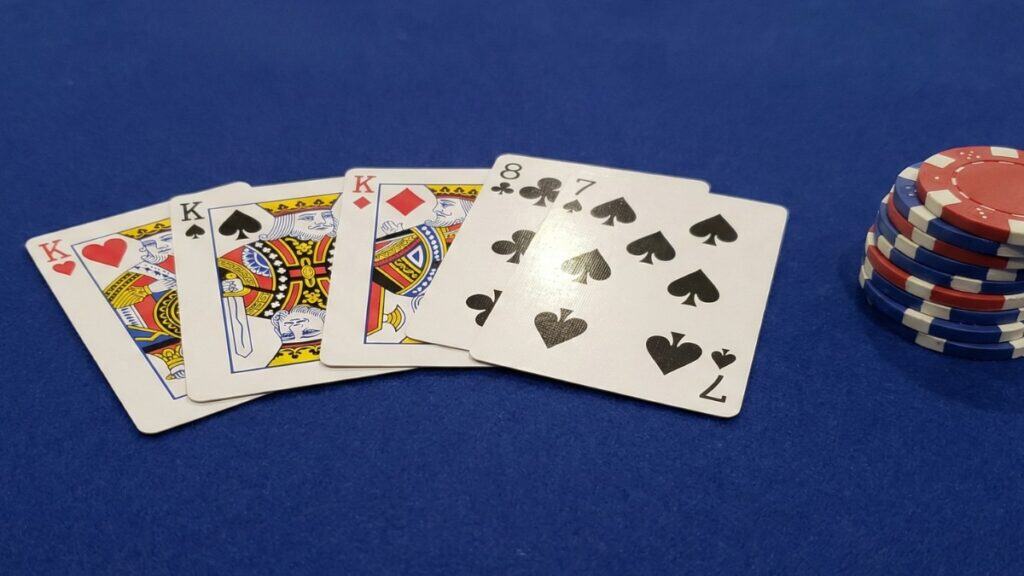
Set vs. Trips Poker Math Behind Three of a Kind Hands
Set vs. trips is the difference between a disguised three of a kind (a set) and a board-paired three of a kind with kicker risk (trips).
You’re probably wondering, “What are trips in poker?” or “What is a set in poker?” Here is the practical answer: the difference between trips and a set determines how often you are dominated, how hard you can value-bet, and how often you should control the pot on paired boards.
Set vs. Trips Poker: What Are Trips in Poker?
Trips poker refers to any made hand containing three cards of the same rank, a threshold that places it above one pair and below a straight in standard hand rankings.
Board-Paired Trips From One Hole Card
The most common form of trips occurs when a single hole card pairs with a duplicated rank on the board. Holding Ace of hearts on a board reading Ace of spades, Ace of diamonds, 9 of clubs, and 4 of hearts creates trips with a kicker.
This configuration appears frequently in single-raised pots because paired flops are not rare events.
The structural weakness lies in exposure. Any opponent holding the same rank with a higher kicker shares the same three of a kind and wins at showdown. On paired flops, optimal strategies reduce turn and river aggression because kicker share and board pairing compress value.
GTO Wizard’s paired-board work shows why these boards create higher risk premiums and more checking than most unpaired textures, which is the real driver behind the trips vs set gap.
| Trips Spot | Main Problem | Default Plan |
|---|---|---|
| Flop paired, weak kicker | Dominated trips, thin value | Check more, small bets |
| Flop paired, strong kicker | Fewer dominated outcomes | Bet more, still cautious |
| Turn pairs board | Boat draws widen ranges | Pot control, call more |
| River pairs board | Value narrows sharply | Target bluff-catchers |
Trips as a Non-Premium Made Hand
Any trips poker result depends on construction, but the key math you can trust is that paired flops are common enough that board-paired trips show up frequently in single-raised pots. This is precisely why the kicker problem matters so often in practice.
This classification explains why trips rarely warrant automatic commitment, a mistake that shows up repeatedly in hand reviews at top online poker sites.
Set vs. Trips Explained: What Is a Set in Poker?
A set is a three of a kind formed when a pocket pair connects with the board to create the third matching rank.
Unlike most trips poker scenarios, this structure produces a concealed strength profile that routinely captures oversized pots, because opposing ranges rarely account for it.
Pocket Pair Construction and Frequency
The defining feature of a set is ownership of a pocket pair before the flop. Holding 8 of hearts and 8 of clubs on a board that later reveals an 8 of spades completes the hand. This construction guarantees kicker immunity because no opponent can hold the same rank twice in their hole cards.
From a mathematical standpoint, the probability of flopping a set with a pocket pair is approximately 11.8 percent, or about once every 8.5 occurrences. That 11.8 percent comes from combinations using n choose k math, specifically: (C(2,1)×C(48,2))/C(50,3)=0.118, or 11.8 percent.
When including turn and river outcomes, the cumulative chance of completing a set by showdown rises to roughly 19.6 percent. Those figures explain why disciplined preflop calls with small and medium pairs remain profitable in deep-stacked environments.
| Pocket Pair Result | Flop Chance | By River Chance |
|---|---|---|
| Flop a set | 11.8% | 11.8% |
| Improve to set | N/A | 19.6% |
| Miss by river | N/A | 80.4% |
In a $1/$2 no-limit Hold ’Em cash game with 100 big blind stacks, calling a $6 open with a pocket pair requires winning an average of $45 to $55 when a set hits to offset misses. That target is routinely met in games where opponents overcommit with top pair or overpairs.
The concealed nature of a set allows aggressive value lines without telegraphing hand strength, a dynamic amplified in anonymous pools and fast-fold formats common across Bitcoin and Ethereum poker sites, where population tendencies skew toward autopilot continuation betting.
Why Sets Generate Outsized Pots
Sets extract value because they collide with the top of opposing ranges, rather than marginal holdings. Overpairs, top pair with strong kickers, and two-pair combinations frequently pay multiple streets against a disguised three of a kind.
Sets win bigger because they are underrepresented in ranges after you just call preflop, so opponents keep betting overpairs and top pair into you, a pattern also emphasized in modern solver-based training material on value selection and board interaction.
Board texture reinforces that edge; on unpaired flops such as King of diamonds, 8 of spades, and 4 of clubs, a hidden set faces minimal immediate resistance while retaining substantial equity against drawing hands. Even when coordinated turns introduce straight or flush possibilities, the set remains robust enough to continue betting for value.
This structural advantage anchors the difference between trips and a set. While every set qualifies as trips, its method of construction transforms how the hand should be valued, sized, and driven toward showdown in the broader set vs. trips framework.
Difference Between Trips and a Set in Poker Strategy
The difference between trips and a set defines how much risk is embedded in a three of a kind.
Kicker Vulnerability and Range Collisions
Trips most often arise when one hole card matches a paired board. That structure leaves the kicker in play, creating scenarios in which two players share the same three of a kind, with the higher side card determining the winner. In practical terms, this means trips can be second-best without any visual warning from the board.
A concrete example highlights the issue: On a board of Queen of hearts, Queen of clubs, 7 of diamonds, 3 of spades, and 2 of hearts, holding the Queen of spades and the Jack of diamonds produces trips with a Jack kicker. Any opponent holding the Queen of diamonds and the Ace of clubs wins the pot outright.
Sets remove that risk entirely. With a pocket pair, no opponent can share the same rank twice, making a set the strongest possible three of a kind for that card. This immunity allows larger bet sizing without fear of hidden domination. The distinction becomes even sharper in multiway pots where overlapping ranges amplify kicker conflicts for trips poker holdings.
In practice, that means you should build bigger pots with sets and use smaller, later-street lines with trips on paired boards.
In a $1/$2 cash game, you call a $6 open with pocket 8s and the flop comes King of clubs, 8 of diamonds, 4 of spades ($13 pot). Bet $8 to target top pair and overpairs. The turn is the 2 of hearts ($29).
Bet $22 to pressure one-pair holdings. The river is the Jack of spades ($73). Bet $55 for value against Kings and stubborn pairs. With trips on a paired flop, the same line risks overvaluing a kicker-dependent hand.
| Hand Type | How It Is Made | Primary Risk |
|---|---|---|
| Trips | One card matches paired board | Kicker domination |
| Set | Pocket pair hits third card | Draw runouts |
| Full House | Trips plus paired board card | Quads overboats |
Equity Retention Across Streets
Equity retention separates profitable aggression from controlled value extraction. Trips lose equity as additional cards are revealed because redraws and kicker conflicts multiply. Sets retain a higher share of their initial equity through the river, making them suitable for sustained pressure.
On paired boards, trips face more domination and redraw pressure than sets, so they realize less value on later streets. That gap translates into higher expected value when building pots early with sets and more cautious lines with trips.
This framework explains why the poker trips vs set distinction matters beyond terminology. It shapes betting architecture, informs bluff-catching thresholds, and prevents overvaluation of hands that appear strong but degrade quickly.
The concept is occasionally misunderstood by players coming from video poker casinos, where hand value is static, rather than range-dependent.
Set vs. Trips Strategy in Modern Poker Environments
The strategic gap between these hands widens as games scale in speed, stack depth, and solver-influenced play, making precision mandatory, not optional.
Value Extraction With Sets in Deep Stacks
Sets support aggressive value lines because their equity profile remains resilient across streets. In deep-stacked cash games and late-stage tournament play, solver-approved strategies favor larger bet sizing on dry and semi-coordinated boards when a set is present.
This approach captures value from overpairs and top-pair holdings that continue too wide.
The 2025 paper “Beyond Game Theory Optimal: Profit-Maximizing Poker Agents for No-Limit Hold ’Em” frames profit maximization as moving beyond equilibrium when opponents overcontinue, which directly supports larger early-street value lines with concealed strength like sets.
Use it here to justify one practical rule: when you have a set on a dry flop, size up earlier, because callers are weighted to one-pair hands, not boats.
Rule environments matter as well. In games with deeper buy-ins and slower blind structures, sets are worth more because opponents retain chips to commit. This effect is visible at high payout sites, where deeper stacks and lower rake caps allow sets to convert equity into larger absolute returns over time.
Controlled Lines With Trips Poker Holdings
Trips poker demands restraint. Because kicker exposure and board texture erode equity, optimal play often involves smaller bets or delayed aggression.
On paired boards, checking trips more frequently protects against domination and keeps weaker holdings in the pot.
Mastering Poker Trips vs Set
A set is trips with no kicker problem, which is why it supports bigger value lines and earlier pot building.
Trips poker is usually board-paired, so it loses money when you bet like you are always “locked,” especially against ranges that include the same rank with a better kicker. Treat the poker trips vs set distinction as a sizing rule: sets push value, trips protect equity.
Please play responsibly. 21+, T&Cs apply.