

How to Play Mississippi Stud Poker
Mississippi Stud poker is a house-banked table game that pays from a posted paytable, not against a dealer hand. The final hand is always five cards (two private plus three community), so standard five-card frequencies apply: the Ante qualifies (push or better) about 20.63% of the time.
About 13.00% finishes as Jacks-or-better one pair (Ante push), while about 7.63% ends as two pair or better (the portion that actually pays the Ante). Some players spell it Mississippi Stud; casinos list it under “Mississippi Stud.”
Mississippi Stud Poker Rules And Betting Flow
Maryland’s regulator-written standard rules are useful here because they spell out the betting boundaries, the card-handling limits, and what happens if a player breaks procedure. Those details change outcomes at the table, so the “how it works” part stays grounded in enforceable steps.
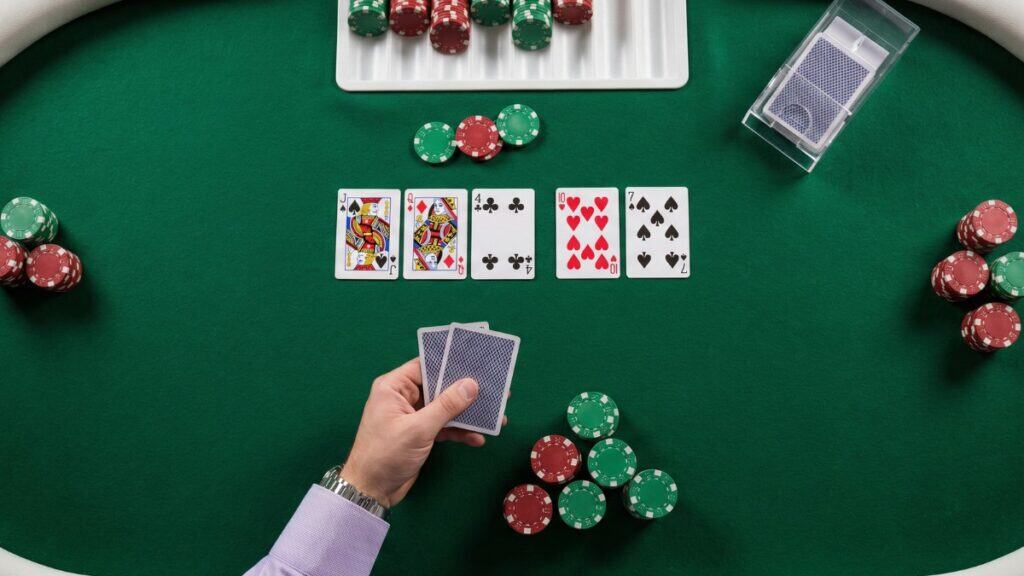
A round starts with an Ante wager. Two player cards are dealt face down, along with three community cards that begin face down. After players look at their own cards, the first decision arrives before any community card is turned: a player either folds or places a 3rd Street wager sized at 1×, 2×, or 3× the Ante.
Next, the dealer reveals the first community card. A player who’s still in either folds or makes a 4th Street wager, again 1×, 2×, or 3× the Ante. The second community card is revealed; the same choice repeats for the 5th Street wager at 1×, 2×, or 3× the Ante. After the third community card is revealed, hands are evaluated as the best five-card poker hand built from the two player cards plus the three community cards.
Rule boundaries matter because they carry real consequences. These standard rules state that violations like another person touching a player’s cards, failing to keep cards in view, or communicating about a hand before all community cards are revealed can trigger forfeiture of all wagers for that round.
Mississippi Stud Payouts And Hand Rankings
Regulator-issued game rules define how Mississippi Stud payouts work, which matters because every outcome is settled strictly against the posted paytable. The Maryland Lottery and Gaming Control Agency publishes a standard Mississippi Stud schedule used as an operational reference by licensed casinos; the figures below reflect that structure and how hands are graded in real money poker settings.
| Hand Result | Payout Multiple | Pays On |
|---|---|---|
| Royal Flush | 500 to 1 | Ante only |
| Straight Flush | 100 to 1 | Ante only |
| Four of a Kind | 40 to 1 | Ante only |
| Full House | 10 to 1 | Ante only |
| Flush | 6 to 1 | Ante only |
| Straight | 4 to 1 | Ante only |
| Three of a Kind | 3 to 1 | Ante only |
| Two Pair | 2 to 1 | Ante only |
| Pair of Jacks+ | Push | Ante only |
| Pair Below Jacks | Loss | Ante only |
Only the Ante wager is evaluated against the paytable. All street wagers resolve at 1 to 1 if the hand qualifies and lose if it doesn’t. That separation explains why the bet line matters: qualifying hands return 1:1 on street wagers, but non-qualifying hands lose the Ante and every street bet, so higher multiples increase downside far faster than they increase the value of a push.
Decision Points Across The Hand
Mississippi Stud revolves around timed choices rather than opponent reads. Each decision locks in exposure that can’t be adjusted later, which is why mississippi stud poker strategy focuses on restraint and timing rather than aggression.
- After receiving two cards: A player decides to fold immediately or place the 3rd Street wager. Folding here ends the hand with the Ante lost; staying in commits the player to future reveals.
- After the first community card: The 4th Street decision reacts to partial information. Raising here increases total exposure before the hand is fully visible.
- After the second community card: The 5th Street wager is the final choice before resolution. No later action can correct an overcommitment made at this stage.
A typical decision scenario highlights the stakes. A player holds two unsuited low cards, makes a minimum 3rd Street wager, then sees the first community card pair one of those ranks. Continuing at the minimum keeps exposure contained; jumping to a higher multiple magnifies losses if later cards miss. That choice changes the outcome even though the final hand strength stays the same.
Mississippi Stud Strategy Without Calculations
Strategy is mostly exposure control tied to hand quality, not opponent behavior. Bigger multiples make sense when the hand is already likely to finish in two pair or better, since that is the portion that actually pays the Ante.
Use this street guide as a baseline. On 3rd Street, 3× fits any pair or two strong high cards; 1× fits a single high card with a live draw feature; folds are for weak, unconnected low cards. On 4th Street, step up only with made improvement (pair+) or a clear live draw; otherwise keep it small or exit. On 5th Street, higher multiples belong to two pair+ or strong improvement paths; thin one-pair lines stay minimal or fold.
Quick decision grid: 3× = pair/two-pair+ path; 1× = marginal but live; fold = dead start or dead turn.
Limits of Mississippi Stud Poker Strategy
Casino rules place firm edges around what mississippi stud strategy can accomplish. Maryland’s standard rules matter here because they define actions that are allowed and the penalties tied to breaking them; strategy choices exist only inside those lines.
- Fixed raise sizing
Players can raise only in preset multiples of the Ante. No rule allows creative sizing, partial raises, or delayed increases. - No card replacement or redraws
Once cards are dealt, they stay in play. Discarding, swapping, or exposing cards early triggers dealer intervention. - Single-hand isolation
Discussing cards or receiving input from other patrons is prohibited. If that boundary is crossed, the house may void wagers. - Uniform rules across formats
Digital versions offered on casino platforms with poker follow the same raise limits and hand evaluation logic as live tables; software doesn’t loosen those constraints.
These limits explain why long-term outcomes hinge on discipline rather than clever manipulation of the game flow.
How Mississippi Stud Plays In Different Environments
Mississippi Stud follows the same rule boundaries in physical casinos and digital formats, though the experience changes. State regulators require identical betting multiples, hand rankings, and payout logic across approved platforms, which means software versions mirror live tables in how wagers resolve.
The difference shows up in enforcement and pace. In a live casino, a dealer may pause the game to correct card exposure or clarify a wager. In regulated digital products, software blocks invalid actions automatically. Crypto poker rooms and apps are a separate category; if Mississippi Stud appears there, paytables and procedures can be house-set and may not match regulator language.
Understanding Mississippi Stud Odds
Mississippi Stud ends as a five-card hand (2 hole cards + 3 community cards), so final-hand frequencies follow standard five-card poker math. Under those frequencies, the Ante qualifies (push or better) about 20.63% of the time. Roughly 13.00% of hands finish as Jacks-or-better one-pair, which pushes the Ante on the schedule shown, while about 7.63% land at two pair or better, which is where the Ante actually pays.
The part that drives results is exposure. Each street bet is an additional multiple of the Ante, and those wagers pay 1:1 only when the final hand qualifies.
Quantified example: With a $10 Ante and 1× on 3rd, 4th, and 5th Street, total action is $40. A Jacks-or-better one pair pushes the Ante and wins $30 on the streets for +$30 net; two pair pays $20 on the Ante plus $30 on streets for +$50 net. With 3× on all three streets, total action becomes $100, and a non-qualifying finish is –$100 net.
When Mississippi Stud Hands Trigger Disputes
Procedure issues matter when a hand gets compromised mid-round, since the ruling can override what the cards would have paid.
Nevada’s regulator-published rules for a Mississippi Stud variant state that a Low Hand Bonus side bet can still be evaluated even if the player folds the base game, with the dealer placing the folded cards under the side wager per house procedure.
Rule/procedure scenario: After the first community card turns, a player accidentally flashes both hole cards to a neighbor. The dealer stops the action, calls the floor, and the decision hinges on the rule trigger: card security and game integrity. A compromised hand can be ruled dead or have action forfeited, depending on timing and how the exposure occurred.
Reading Mississippi Stud for What It Is
Mississippi Stud plays best when it’s treated as a bet-timing game, not a contest against another hand. Each street decision locks in exposure that can’t be reversed, so restraint matters more than bold raises.
Paytables matter for the same reason: the Ante qualifies one way, and the street wagers settle another way, so the same final hand can land differently based on how the betting line was built. A clean routine helps: fold early when nothing connects, then resist chasing when later cards don’t improve the picture.
Call 1-800-522-4700 for gambling help.