

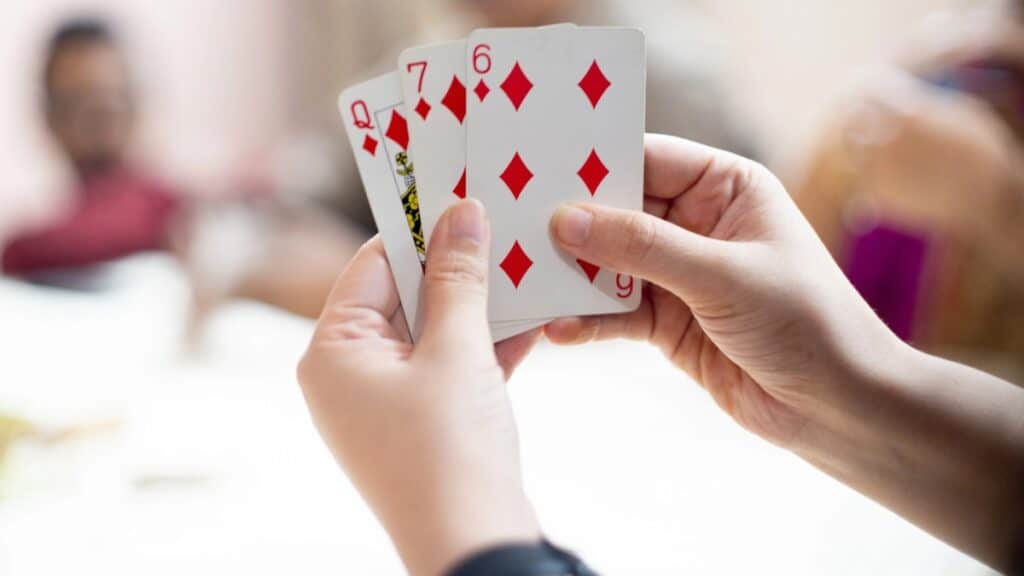
Indian Poker: The Blind Card Social Game
Indian Poker rules define a unique variant in which players see all opponents’ cards except their own. Mastery comes from exploiting informational asymmetry through opponent observation, betting patterns, and two card variations rather than applying standard poker logic.
What Is Indian Poker
Indian Poker is a card game in which each player holds a card face up on their forehead without seeing it. Players see all opponents’ cards but none of their own, creating an asymmetric-information structure that rewards deduction and probabilistic reasoning.
Indian Poker Game Origins
Indian Poker emerged as a casual social card game in the mid-20th century, commonly played in informal settings rather than organized poker rooms. The name derives from the tradition of holding cards to the forehead, though many modern players prefer neutral terms such as “Forehead Poker” or “Blind Card Poker.”
Game Setup and Card Distribution
Standard setup requires a 52-card deck and 3-8 players. Each player receives one card face down, then simultaneously places it on their forehead, facing outward, without viewing. Some variants use two cards per player (two card Indian poker), increasing the complexity through hand rankings.
Indian Poker Strategy
Indian Poker strategy is fundamentally a deduction and expected-value problem under asymmetric information. Unlike standard poker—where players infer opponents’ hands—Indian Poker inverts the logic: opponents see your card perfectly, while you infer your own card strength from visible card distribution and betting behavior.
This structure closely resembles formally studied incomplete-information games such as Kuhn Poker, a canonical one-card poker model introduced by Harold W. Kuhn (1950), which is widely used in game-theory literature to analyze optimal bluffing and betting under extreme information constraints.
Information Analysis Framework
Each player observes:
- All opponent cards (face-up)
- Zero direct information about their own card
- Betting actions that encode opponents’ beliefs about their unseen holdings
Optimal play therefore depends on conditional probability, not intuition.
1. Visible Card Distribution (Primary Signal)
Your unseen card is drawn from the remaining deck after removing all visible cards. As more high cards are visible, the probability mass of high ranks in your unseen card collapses.
Example (single-card, 5-player game):
- Visible cards: 2, 4, 6, 7
- Remaining deck size: 48 cards
- Cards that beat all visible cards: ranks 8–Ace → 28 cards
- Cards that lose to at least one visible card: ranks 2–7 → 20 cards
P(your card beats all visible cards) ≈ 58%, before accounting for betting behavior.
This is why betting aggressively into mostly low visible cards is often +EV, even with no knowledge of your exact rank.
2. Relative Rank Compression (Mid-Card Bias)
Extreme outcomes (very high or very low cards) are less likely than mid-range ranks once multiple cards are exposed.
Example:
- Visible: 3, 5, 7, 9, J
- Remaining high cards (Q, K, A): only 12 total
- Remaining mid cards (6, 8, 10): 12 total but dominate more opponent holdings
This creates a mid-card bias, where betting strategies should assume your unseen card is more likely to be competitive than dominant or crushed.
Betting Strategy by Visible Distribution
| Visible Opponent Cards | Optimal Bias | Rationale |
|---|---|---|
| Mostly low (2–7) | Aggressive betting | Majority of unseen cards outrank visible field |
| Mostly high (10–A) | Conservative / folding | Probability mass shifts below visible ranks |
| Mixed distribution | Reactive | Weight opponent bets more heavily than raw cards |
Importantly, aggressive betting does not imply certainty—only that expected value favors pressure when most remaining ranks are winning ranks.
Interpreting Opponent Bets
Because opponents see your exact card, their betting reflects their inferred strength, not yours.
- Aggressive betting from a player facing mostly strong visible cards suggests they believe their unseen card is unusually strong.
- Passive play from a player facing weak visible cards suggests uncertainty or a weak inference.
This mirrors Kuhn Poker equilibria, where betting frequency—not hand strength alone—encodes private information.
Bluffing Dynamics
Bluffing in Indian Poker is structurally limited.
- If opponents see your card is low, bluffing is usually −EV unless visible card clustering creates uncertainty about their own holdings.
- If opponents see your card is high, value betting dominates; deception adds little because opponents’ calling ranges already adjust perfectly to your known strength.
The strategic edge therefore comes not from deception, but from exploiting opponents who miscalculate the probability of their own unseen cards.
Core Strategic Principle
Indian Poker shifts value away from hiding information and toward exploiting probabilistic inference errors.
Players who rely on “gut feel” or standard poker heuristics systematically lose to players who treat each hand as a conditional probability and expected-value problem.
Indian Poker Rules
Indian poker rules establish the betting structure, hand-evaluation criteria, and showdown procedures, determining winners in this information-asymmetric format.
Basic Gameplay Structure
Indian Poker follows: ante posted, cards dealt face-down, cards placed on foreheads without viewing, single betting round (check/bet/call/raise/fold), showdown among remaining players, and the highest card wins (Ace high).
The single betting round creates rapid gameplay based purely on visible opponent cards and betting behavior.
Betting Round Mechanics
Betting begins to the left of the dealer and proceeds clockwise. Players may check, bet, call, raise, or fold. Standard structures include fixed-limit (predetermined amounts), pot-limit (maximum equal to the pot), or no-limit (any amount up to the stack).
Hand Evaluation and Showdown
After betting concludes, remaining players reveal their cards. In single-card Indian Poker, the highest visible rank wins, but unseen card probabilities heavily influence optimal betting behavior.
The probabilities below are illustrative only, based on a simplified model: a single 52-card deck, no jokers, no card removal beyond the visible up-cards, and no weighting for player behavior or betting dynamics. They are intended to show directional tendencies, not exact expected values.
Assumptions used for illustration
- One-card Indian Poker variant
- Standard 52-card deck
- No folded cards removed from the probability pool
- All unseen cards treated as equally likely
| Card Rank | Approximate Unseen Probability* |
|---|---|
| Ace | ~7.7% |
| King | ~7.7% |
| Queen | ~7.7% |
| Jack | ~7.7% |
| 10–2 | ~61.5% |
Because high cards are more likely to be visible to opponents in multi-player games, the practical probability of holding a mid-to-low unseen card increases as more high ranks appear on other players’ foreheads. When three or more high cards are visible, the chance that your unseen card ranks below Jack rises substantially, which explains why aggressive betting often performs better in low-card distributions — even without knowing your exact card.
Those seeking competitive environments often evaluate the best online poker sites that offer diverse variant offerings, where strategic skills transfer across formats.
Two Card Indian Poker
Two card Indian poker increases strategic complexity by introducing hand rankings and multiple card combinations.
Two Card Rules Modifications
Players receive two cards instead of one, holding both to their foreheads. Opponents see complete two card holdings while players remain blind to their own hands. In two card Indian poker, standard poker hand rankings apply: pairs always beat high cards, with strength determined by rank (Aces highest, 2s lowest).
This structure creates significantly more complex analysis. With two cards visible per opponent in a five-player game, eight cards (16% of the deck) become known, increasing deductive reasoning requirements.
Strategic Adjustments for Two Card Format
Pair Probability Assessment: Seeing no pairs among opponents suggests increased pair probability for your unknown holding (though still unlikely at approximately 5.9% base rate).
High Card Evaluation: Seeing two high cards per opponent (multiple Kings, Queens, Aces) dramatically reduces the likelihood that your unknown two cards beat visible competition.
Implied Odds Consideration: In multi-street variants, drawing potential becomes relevant. Holding unknown cards while seeing a few matching ranks among opponents creates uncertainty about pair draws (though traditional Indian Poker employs single betting rounds).
Advanced Indian Poker Concepts
Beyond basic strategy, advanced players incorporate positional considerations, range awareness, and opponent-tendency exploitation to maximize their edge in competitive settings.
Positional Strategy
Early position requires conservative play without strong signals. Late position benefits from observing earlier betting, enabling aggressive play when opponents show weakness. Button position provides maximum advantage with complete betting visibility.
Metagame and Opponent Tendencies
Regular groups develop predictable dynamics over time:
- Tight players fold frequently and are exploitable through sustained aggression.
- Loose players call with weak holdings, providing clear value opportunities.
- Observant players track visible cards and adjust betting, making them harder to exploit.
- Impulsive players bet emotionally, creating volatility and exploitable patterns.
Table Selection
Select games with recreational players for better expected value. No-limit structures increase variance but reward skilled play. Deep stacks allow aggressive pressure; short stacks create push/fold dynamics.
Digital platform enthusiasts seeking blockchain-based gaming often investigate crypto sites where provably fair card distribution and transparent game mechanics attract players who value verifiable randomness.
Common Indian Poker Mistakes
Recognizing frequent errors helps players avoid costly strategic leaks while maximizing advantages in information-asymmetric gameplay.
Ignoring Visible Card Distribution
The most common error involves betting without analyzing the visible card distribution. Players focus on their forehead card being “unseen” without considering that opponents’ visible cards provide strong probabilistic information about their own holding.
Example Error: Seeing three opponents with 2, 4, 6, and betting conservatively due to “uncertainty.” Optimal play involves aggressive betting, recognizing that most unseen cards beat visible low cards.
Overvaluing Position on Highly Visible Cards
Players seeing their forehead card ranks high (King or Ace visible to opponents) sometimes overbet, assuming strength. However, opponents who know the exact card value can call appropriately when holding higher unseen cards or fold when beaten.
Correction: Value bet moderately with high visible cards rather than overcommitting. Opponents’ calling ranges adjust perfectly to your exact strength, limiting extractable value.
Underutilizing Opponent Betting Patterns
Skilled players derive significant information from opponent betting despite having no card knowledge. An opponent who bets aggressively with visible 3s likely deduces a strong holding from the surrounding visible cards. An opponent with visible King-checking may hold a Queen or lower.
Application: Weight opponent betting behavior heavily when making decisions. Their bets reflect their deductions about their own unseen cards based on visible information.
Applying Standard Poker Strategy Directly
Traditional poker strategies (tight-aggressive, position-based ranges) translate poorly to Indian Poker’s inverted information structure. Standard hand reading becomes irrelevant when all hands are visible; instead, reading opponent deductions about their blind holdings becomes paramount.
Adjustment: Develop Indian Poker-specific strategies focused on probabilistic reasoning and opponent psychology rather than importing standard poker frameworks directly.
Developing strategic thinking across poker variants strengthens understanding of game theory, which aspiring players can enhance through structured poker lessons covering fundamentals applicable across diverse formats, including recreational variants.
Embracing the Asymmetric Challenge
Indian poker strategy inverts traditional hidden-information dynamics, creating unique psychological and deductive challenges. Success requires shifting from hand-reading to probability analysis and to interpreting opponent behavior.
Whether playing casually or competitively, mastering Indian poker rules and adapting to asymmetric information structures provides engaging entertainment while developing transferable skills in probability assessment, opponent psychology, and strategic reasoning applicable across poker variants and decision-making contexts.
Please play responsibly. 21+, T&Cs apply.