

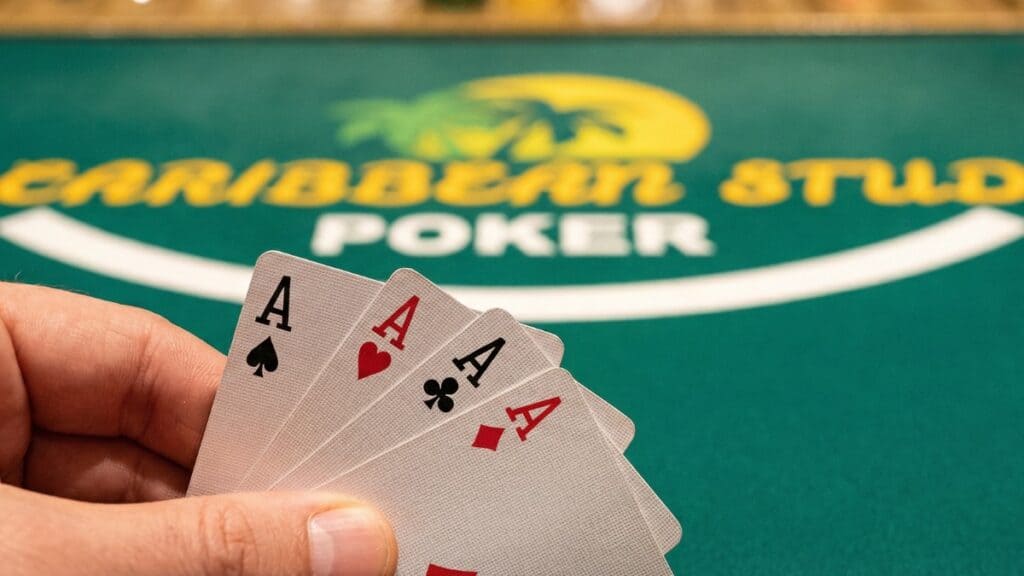
How to Play Caribbean Stud Poker
Caribbean stud poker is a five-card house game played with a single 52-card deck. You place an ante, receive five cards, see one dealer upcard, then either fold or raise with a second bet equal to the ante.
If the dealer misses qualification, the ante pays even money, and the raise is a push, but once the dealer qualifies, ante and raise both pay or lose based on the paytable.
Caribbean Stud Poker Rules: From Ante to Showdown
Caribbean poker follows a fixed sequence closer to blackjack than to player-versus-player poker.
Each seat places an ante, often between 5 and 25 dollars in US live casinos, then receives five cards face down while the dealer takes five with one card face up. After checking your hand, you either fold and surrender the ante or raise with a second bet equal to the ante to continue against the dealer.
Once decisions finish, the dealer exposes the remaining four cards. Standard Caribbean poker rules say the dealer qualifies with at least Ace–King high. An unqualified dealer pays the ante at 1 to 1 and returns the raise as a push. A qualified dealer hand triggersa full comparison; if your hand wins, both ante and raise pay according to the posted schedule, and if the dealer wins, both bets lose.
Bets, Side Jackpots, and Caribbean Stud Payouts
Every hand starts with the ante, then either ends when you fold or carries a matching raise plus any optional progressive side chip. The base game pays even money on the ante when you beat a qualifying dealer and uses a fixed odds ladder on the raise.
The progressive side bet is separate. It usually costs a flat 1 dollar per hand and sends around 2 to 5 percent of each bet into a jackpot pool that may start near 50 000 dollars and grow across linked tables.
- Ante pays 1 to 1 against a qualifying dealer hand.
- Raise follows a posted odds ladder based on final hand rank.
- Progressive side bet can pay fixed bonuses on strong hands.
- The top jackpot tier usually locks to a royal flush in the player hand.
Standard Pay Table: Hand Rankings and Returns
Most modern Caribbean stud layouts use a similar pay schedule, even if exact numbers change between operators. The ante pays 1 to 1 on any qualifying win, while the raise scales with hand strength on the ladder below. The dealer qualifies with Ace–King or better roughly 77 percent of the time and fails about 23 percent, so many rounds pay the ante while the raise pushes.
| Hand | Typical Payout on Raise | Example Progressive Prize | Example Operator Rule Note |
|---|---|---|---|
| Royal flush | 100:1 | Jackpot (e.g., $200,000) | Pays flat jackpot on a 1$ side bet |
| Straight flush | 50:1 | 5 000$ | Smaller fixed side prize |
| Four of a kind | 20:1 | 500$ | Side bonus only at select properties |
| Full house | 7:1 | 100$ | No side prize, main game payout only |
| Flush | 5:1 | 75$ | Some variants reduce side prize here |
| Straight | 4:1 | 50$ | Often the lowest progressive trigger |
In any five-card deal, most outcomes still fall into high-card or one-pair territory; one pair appears in a little over 42 percent of hands and high-card only around 50 percent, while premium hands such as full houses and better arrive well under 1 percent of the time. That distribution explains why the paytable pushes most long-term value into rare results.
House Edge, RTP Numbers, and Progressive Contributions
Caribbean stud runs on fixed math. On the standard U.S. paytable that pays 100:1, 50:1, 20:1, 7:1, 5:1, and 4:1 on the raise, the optimal basic strategy gives a house edge of about 5.224 percent against the ante, or roughly 94.8 percent RTP. Small changes to that ladder can shift the edge by close to a full percentage point.
In live poker areas, minimum antes often sit between 10 and 25 dollars, while tables at online poker sites may start at 1 dollar. When rules and paytables match, the underlying RTP stays the same even if pace and presentation change.
The progressive side bet follows separate math. A typical $1 chip sends around 2 to 5 percent of each wager into a shared jackpot meter and carries a double-digit house edge until the jackpot climbs into high six figures. That contribution pulls effective RTP down even further right after a reset, when the meter sits near its seed value.
Straightforward Strategy: When to Fold or Raise
Basic strategy for Caribbean stud aims to trim the house edge toward published figures instead of chasing every pot. The rules of thumb below track closely with near-optimal charts derived from full game simulations on the standard U.S. paytable at Wizard of Odds.
- Always raise with a pair or better. Any made hand with at least a pair has enough equity against a qualifying dealer range to justify the extra bet in the long run.
- Fold weaker than Ace–King. Queen-high and below sit too far behind the dealer’s qualifying threshold; raising those holdings lifts the house edge instead of shrinking it.
- Treat Ace–King as the borderline case. Raise Ace–King when supported by a strong kicker structure, such as Ace–King–Queen–x–x or Ace–King–Jack with a middle card that outranks the dealer’s upcard. Fold Ace–King with low side cards when the dealer shows an Ace or King that outkicks your remaining cards.
On this standard paytable, simplified rules such as raising any Ace–King push the house edge above 5.5 percent, while raising every hand drives it past 16 percent. A compact Ace–King chart keeps results close to optimal without a full decision tree.
Common Mistakes That Hurt Long-Term Returns
Caribbean stud has simple rules, yet a few habits push the math further toward the house. Raising almost every hand is the biggest leak; basic strategy trims the edge to roughly 5 percent, while always raising can push it into the mid-teens.
Overusing the progressive side bet is another drag. A flat 1 dollar chip each hand looks small, but long sessions feed a jackpot you rarely hit, especially right after a reset when the meter has low effective value.
Many players also overlook dealer qualification. Forgetting that the dealer needs at least Ace–King high leads to confusion when a strong player hand only earns the ante. Reading the posted paytable and qualification rule before the first ante sets clearer expectations at showdown.
Online Poker Rooms With Caribbean Stud Tables
Regulated online poker rooms that share platforms with casino games now host several versions of Caribbean stud poker. Lobbies often carry Evolution’s live Caribbean stud table or similar titles, with main-game RTP often posted around the 97–98 percent range when basic strategy is used, depending on local configuration.
Caribbean stud usually sits under table games, often with both a classic layout and a progressive version with a 1 dollar side bet and a jackpot seeded around 50 000 dollars. Game info panels show the pay ladder, dealer qualification rule, and any contribution rate that feeds the progressive meter.
Regulated platforms in the United States and nearby markets publish audit stamps from test labs like eCOGRA or GLI and from state regulators alongside dated paytable sheets, many with 2023 or 2024 update dates, so players can see current math for both base game and jackpot outcomes.
Variants and Local Caribbean Poker Rule Twists
Caribbean poker often appears with small house-specific adjustments that change the math without changing the basic five-card layout. Paytables, dealer qualification, and side jackpots shift from one room to another, so reading those details matters as much as spotting strong starting hands. Local rules can move the house edge by several percentage points and change how often big prizes show up over long play.
- Royal Flush Payout Swaps: Some variants pay 200:1 on the raise for a royal flush instead of 100:1. That richer top prize can lift main game RTP by around 0.5 to 1 percentage point, depending on the rest of the table, while leaving lower hands unchanged.
- Straight Flush and Four of a Kind Adjustments: A few paytables trim straight flush returns from 50:1 to 40:1 or four of a kind from 20:1 to 15:1. Those cuts pull expected value back down, even if the royal line looks generous.
- Dealer Qualification Changes: Certain rooms use a looser dealer qualification rule, such as paying full odds when the dealer holds any King high or better instead of Ace–King. That shift can shave a fraction of a percentage point from the edge yet may pair with tighter payouts elsewhere on the ladder.
- Fixed Bonus Versus Progressive Side Pots: Some Caribbean poker variants replace the progressive with fixed side bonuses, for example 5 000 dollars for a royal and 500 dollars for a straight flush. That model removes contribution rates and jackpot meters, trading headline jackpots for more stable side returns.
The math behind those tweaks shows up clearly when paytables and returns sit side by side. On several documented layouts that use the same dealer qualification rule but different raise payouts, the main-game house edge shifts by several tenths of a percentage point.
| Paytable example | Key raise payouts (royal / straight flush / four of a kind / full house / flush / straight) | Approx. house edge vs ante | Notes |
|---|---|---|---|
| Standard U.S. table | 100 / 50 / 20 / 7 / 5 / 4 | ~5.22% | Baseline layout on many U.S. tables and older RNG games. |
| Normandie Casino, CA | 21 / 19 / 17 / 15 / 13 / 11 | ~4.99% | Heavier emphasis on mid-strength hands; slightly lower edge. |
| Crans-Montana, Switzerland | 100 / 50 / 20 / 9 / 7 / 4 | ~4.45% | Extra return moved into full houses and flushes |
Conclusion – Cards Down, Decisions Made
A clear view of ante and raise rules, dealer qualification, and posted payouts keeps decisions grounded in numbers instead of superstition.
Pick limits, use a basic Ace–King decision chart, and treat any progressive side bet as a small, separate wager; once house edge, paytable, and jackpot rules are clear, Caribbean stud fits into a wider mix of games with realistic expectations.
Set limits before you sit down, and if play stops being fun, call 1-800-GAMBLER for confidential help.