

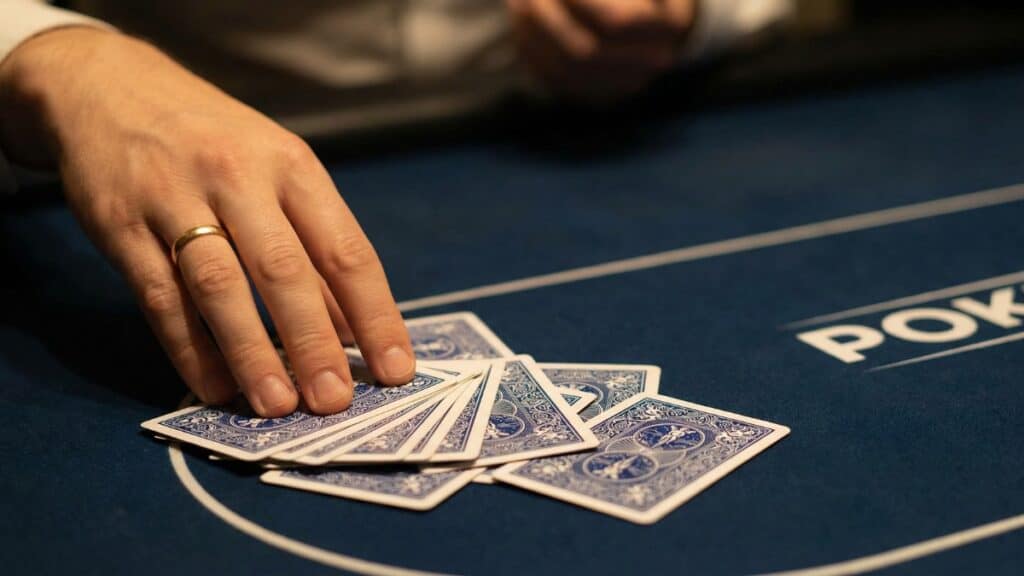
What Does Muck Mean in Poker and What Are the Rules?
What does muck mean in poker? It refers to the dealer-controlled discard pile and the act of surrendering cards so your hand is dead. In live poker, the key issue is identity: once your cards are pushed into the muck and can’t be verified, the hand typically has no claim to the pot under tournament standards.
What Does Muck Mean in Poker?
The meaning of muck starts with a simple idea: a hand is ‘mucked’ when its cards are released and treated as dead, with no further claim to the pot. Players usually muck when they fold, or when they choose not to show at showdown.
In day-to-day muck in poker use, the word can describe an action or a place. As an action, muck poker talk often sounds like, “He mucked after the raise.” As a place, it refers to the dealer’s discard pile, where folded and killed hands go.
This matters in real money poker because the muck is meant to remove ambiguity. If cards are clearly surrendered and mixed into discards, the table can move forward without revisiting the same hand. Players who want their hand considered live must protect it and communicate clearly, since a hand that’s released can be treated as finished even if the player didn’t intend that outcome.
What Is a Muck in Poker as A Physical Area
What is muck in poker, as a noun, is the dealer-controlled discard area where dead cards collect. In many rooms, it’s a defined spot near the dealer’s chip tray or in front of the dealer’s position.
A practical point: the muck isn’t the same as burn cards. Burn cards are placed by the dealer as part of the dealing procedure, separated from the player hands. The muck holds player hands that have been folded or killed.
What Is Mucking in Poker During Active Play
What is mucking in poker refers to the physical act of surrendering a hand so it’s no longer live. That action usually happens face-down and without comment, which is why timing and motion matter.
- Releasing cards to the dealer: A player pushes cards forward after deciding to fold. Once the dealer pulls them in, the hand is treated as dead.
- Failing to protect a hand: Cards left unattended can be swept into the muck during fast action.
- Choosing not to show at showdown: A player may surrender a losing hand rather than table it.
Muck Poker Rules in Live and Tournament Settings
Tournament rules draw the line between a live hand and a dead one. Poker TDA Rule 14 states that the discarding of non-table cards face down will not kill them immediately, if they remain completely identifiable and retrievable. Practical boundary: once either card is mixed into discards or the dealer can’t immediately isolate both cards as yours, treat the hand as dead under the “100% identifiable and retrievable” standard.
Applied example (tournament): River goes bet-call. The bettor tries to slide cards forward face-down to avoid showing. The caller keeps their cards and asks to see the bettor’s hand. Under TDA Rule 18(B) after a river bet, callers have an “inalienable right” to get the last aggressor’s hand tabled if they will, provided the caller “tabled or retains” their own cards.
WSOP 2025 rules do not hinge on a muck-specific clause; they rely on broad enforcement discretion, including sanctions up to forfeiture of chips or prize money and ejection. WSOP 2025 matters here because once a dispute starts, rulings are enforced through general penalty authority rather than re-litigating intent.
Cash games are governed by house rules and floor discretion, not the Poker TDA rule set. The TDA language in this guide is tournament-focused, so a cardroom can apply stricter handling rules in cash play, especially around what counts as a fold motion and whether a hand is considered dead once it crosses a betting line.
Can a Hand Be Retrieved from the Muck?
Once cards hit the muck and mix with other discards, getting them back usually isn’t realistic. The basic issue is identity. If nobody can prove which two cards were yours, a floor decision can’t lean on certainty.
- Timing matters: speak up before the dealer gathers cards.
- Two-step protocol: say “stop” and keep contact with both cards. Call for the floor before the dealer mixes discards.
- Don’t release early: hold cards until action is complete.
- Penalties can cost hands: TDA Rule 71 sets a missed-round penalty as one hand for every player at the table, multiplied by the number of penalty rounds.
Applied example (tournament, non–all-in): River checks through. Player A flashes a card, then starts to slide their hand forward face-down. Before the dealer pulls the hand into discards, A says “wait” and clearly identifies both cards. Under Poker TDA Rule 14, a face-down discarded hand may still be tabled only if it is 100% identifiable and retrievable. If the dealer has already pushed the hand into the muck or the cards can’t be verified as A’s, the hand is dead.
Showdown rights (TDA Rule 18):
- River bet-and-call: caller can require the last aggressor to table on request (18(B)).
- Caller must table or retain their own cards to exercise that right (18(B)).
- If you muck face-down without tabling, you lose the privilege to ask to see hands (18(A)).
Floor-Proof Habits to Avoid Muck Disputes
Live rulings lean on what the dealer can verify in the moment. Use a repeatable handling routine so your hand never looks surrendered.
- Keep both cards on the felt until the pot is awarded.
- Move chips to bet; keep cards still.
- Fold in one clean forward motion; don’t “hover-fold.”
- Say “fold” as you release cards.
- At showdown, don’t release your hand until any request to see the last aggressor is resolved.
Applied example (cash game, common floor ruling): Turn goes bet, call. River checks through. Player A starts to slide their hand forward while looking away, and the dealer reaches to pull the cards in. A says “hold on” before the dealer mixes them into discards and keeps a finger on both cards. In many rooms, that timing is the difference: the hand can still be tabled because the dealer has not killed it into the pile and both cards are still clearly A’s.
Online Poker Versus Live Poker Muck Handling
The difference between live play and online platforms starts with control. In live rooms, players physically release cards; online, the software executes the action. That shift removes ambiguity, but it also removes discretion.
Online poker software resolves folds and showdowns automatically, so there is no dealer discretion about whether a hand is retrievable; in live poker, physical handling creates the muck disputes described above.
Common Misunderstandings About Muck Meaning
Confusion around muck meaning often comes from treating informal home-game habits as if they apply in regulated play. Live rooms and tournaments rely on observable action, not explanations after the fact.
- Mucked cards can’t be reviewed later: an unidentifiable hand has no standing.
- Intent doesn’t override action: releasing cards face-down signals surrender, even without words.
- Dealer action matters: once cards are gathered, reversal usually isn’t supported.
These misunderstandings surface most often when players hesitate after folding, then react to new information. Regulated play resolves that moment through procedure, not debate.
Poker Etiquette and the Muck
Table etiquette around the muck centers on clarity. Players are expected to act decisively, protect live hands, and avoid motions that confuse the dealer. Sliding cards forward and releasing them is widely read as final.
Players coming from bitcoin poker apps sometimes misapply online habits to live hand protection, since the dealer can only rule on what is physically released and what remains identifiable.
Problems tend to arise when cards hover near the betting line or are tossed with force. Those actions invite premature collection or exposure. Clear placement and steady motion reduce friction and help the table move forward without interruption.
Respecting the muck isn’t about courtesy alone. It supports consistent rulings and keeps disputes from slowing the game or escalating unnecessarily.
Table: Muck Outcomes by Player Action
| Player Action | Dealer Response | Hand Status | Dispute Risk |
|---|---|---|---|
| Cards released forward | Dealer collects | Dead | Low |
| Cards tossed forcefully | Cards may expose | Dead | High |
| Cards held at showdown | Dealer waits | Live | Low |
| Cards mixed with discards | Identity lost | Dead | None |
| Cards tabled face-up | Hand evaluated | Live | None |
Understanding the Muck Without Confusion
Knowing what does muck mean in poker comes down to recognizing when a hand ends and why. The muck exists to remove uncertainty, not to punish hesitation. Once cards are released and collected, the game advances based on procedure, not personal intent.
Players who act clearly, protect live hands, and understand the difference between folding and tabling avoid most disputes. That awareness matters in both casual sessions and structured events, where consistency keeps play fair and orderly.
If poker stops being fun, call 1-800-522-4700.