

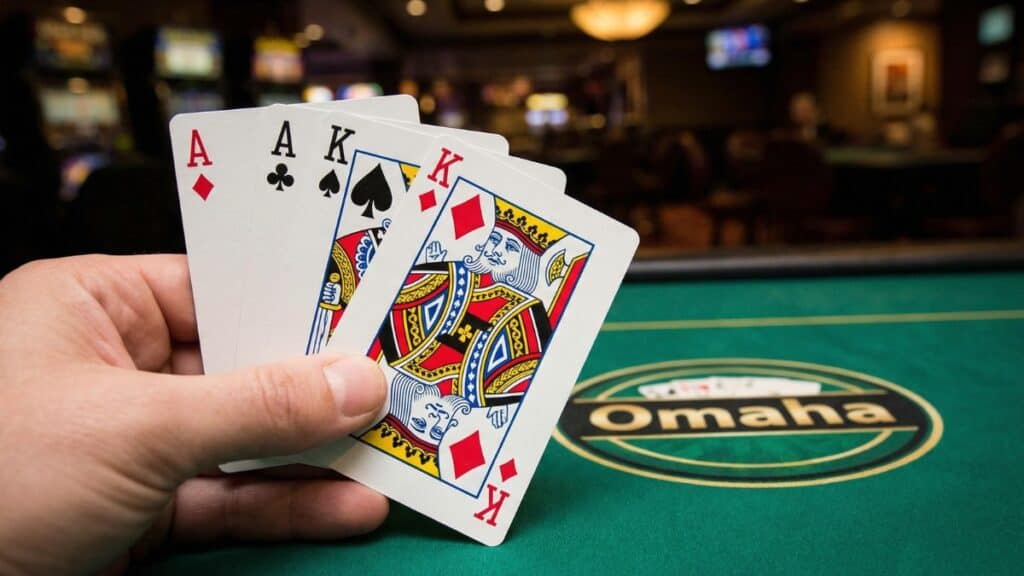
Best Omaha Starting Hand
The best Omaha starting hand is A♠A♥K♠K♥ with double-suited coordination, delivering roughly 67% equity against random hands. These estimates are based on large-sample preflop simulations rather than single-hand outcomes.
Unlike Hold’em, where pocket aces dominate through raw pair strength, Omaha’s four-card structure rewards coordinated combinations that create multiple nut-making paths. High pairs with suited Broadway connections generate stronger long-term value than isolated high cards.
Understanding Omaha Hand Structure
Four-card starting requirements create fundamentally different equity distributions than two-card games.
Why Four Cards Change Everything
Omaha deals four hole cards with the mandatory requirement to use exactly two cards from your hand and three from the board. This structure means holding A♠K♠Q♥J♥ doesn’t create a flush when the board shows four spades. You must use precisely two spades from your hand.
The four-card structure creates 16,432 possible Omaha starting hand combinations compared to Hold’em’s 1,326. However, hand value compression reduces equity gaps between premium and marginal holdings. The best starting Omaha hands hold roughly 67% equity against random opponents, while Hold’em’s pocket aces achieve 85% equity in similar matchups.
Coordination vs. Raw Strength
High cards alone don’t guarantee value in Omaha. A♠A♥7♣2♦ with rainbow suits represents a mediocre starting hand despite containing pocket aces. The hand lacks coordination and makes a top pair but generates no straight or flush draws.
Unlike video poker, where hand strength follows fixed hierarchies regardless of context, Omaha hand evaluation requires assessing coordination between all four cards. Compare A♠A♥7♣2♦ to J♠T♠9♥8♥ double-suited. Despite containing no aces or kings, the connected hand generates wrap straight draws, flush draws, and two-pair possibilities across a range of flop textures.
Best Hands in Omaha: Premium Starting Holdings
The best Omaha hands balance high-card strength with multiple draw possibilities.
Double-Suited Broadway Pairs
A♠A♥K♠K♥ represents the peak starting hand, combining two premium pairs with double-suited potential. The hand makes top set, overpairs, nut flush draws in two suits, and straight possibilities. Against a random opponent, this holding achieves approximately 67% equity pre-flop.
A♠A♥Q♠Q♥ and A♠A♥J♠J♥ follow similar patterns with slightly reduced equity. These hands play profitably from any position and justify aggressive three-betting strategies.
Best Starting Hands in Omaha: Equity Comparison
| Hand Structure | Example | Long-Term Consequence |
|---|---|---|
| Double-suited premium pairs | A♠A♥K♠K♥ | Makes nuts often, dominates multiway pots |
| Double-suited connected Broadway | A♠K♠Q♥J♥ | Creates wraps and nut flush draws |
| Single-suited high cards | A♠K♠Q♥J♦ | Wins small pots, loses big ones |
Rundown Combinations
J♠T♠9♥8♥ exemplifies double-suited rundown power. The hand creates 20-way wrap straight draws on certain flops, double-flush potential, and straight possibilities across multiple combinations. T♠9♠8♥7♥ and 9♠8♠7♥6♥ follow similar patterns, with slightly lower equity due to weaker high-card strength.
Omaha Best Hands: Mid-Range Holdings
These hands play profitably with position but require caution in the early position or when facing aggression.
High Pairs with Weak Coordination
K♠K♥9♦6♣ demonstrates isolated high pair weakness. The pocket kings provide showdown value, but the 9-6 offers minimal coordination. These hands play reasonably in late position for small raises but should fold to three-bets from tight ranges.
Medium Rundowns
8♠7♠6♥5♥ represents solid mid-range potential, with a double-suited rundown creating straight and flush possibilities. The low card values mean losing to higher straights when multiple players make hands.
Suited Broadway Without Pairs
A♠K♠Q♥J♦ demonstrates high-card strength with partial coordination. The A-K suitedness creates nut-flush potential, while the Broadway spread generates straight possibilities. Position becomes critical when these hands play better with information about the opponent’s action before committing significant chips.
Omaha Hand Strength Chart: Categorizing Holdings
Understanding tier structures prevents overplaying marginal combinations by anchoring decisions to expected-value ranges; only the top roughly 12% of Omaha starting hands generate consistent positive EV across positions.
Tier 1: Premium (Top ~12% EV)
These hands justify raising from any position and three-betting against most opponents. Advanced hand-tracking software highlights how certain starting hand structures consistently outperform across large samples, particularly double-suited premium pairs and connected Broadway combinations when played in position on the best online poker sites.
Tier 2: Strong (Next ~18% EV)
Single-suited pocket aces with decent coordination, high pairs with strong side cards (Q-Q with A-K suited), and double-suited sequential cards like T-9-8-7 fall here. These hands call raises profitably and can three-bet selectively based on position and opponent tendencies.
Tier 3: Playable (Middle ~30% EV)
Medium pairs with coordination (J-J with T-9 suited), single-suited rundowns, and high-card combinations with gaps occupy this tier. They require position and favorable pot odds. From early position, many of these holdings should fold to maintain tight opening ranges.
Tier 4: Marginal (Bottom ~40% EV)
Low pairs, poorly coordinated high cards, and disconnected holdings belong here. These hands play profitably only from late position in unopened pots or when defending big blinds against small raises. They fold to any significant action.
Why Coordination Beats Raw Card Strength
The structural difference between Omaha and Texas Hold’em creates unique strategic requirements. A study published in Poker & Gaming Review in 2024 analyzed over 1.8 million Omaha hands, finding that double-suited coordinated hands (like J-T-9-8 suited) outperformed single-suited high-card hands (like A-K-Q-2 with one suit) by 14% in realized equity despite lower pre-flop equity calculations.
The research attributed this to draw completion rates and the ability to make disguised nuts on coordinated boards, where high-card hands frequently result in second-best holdings.
Large-scale simulations run on Omaha analysis tools such as ProPokerTools consistently rank double-suited premium pairs and connected rundowns among the highest-performing starting hands by long-term realized equity.
Multiple Draws vs. One Strong Feature
A♠A♥7♣2♦ makes one strong feature: pocket aces. It generates no flush draws and minimal straight potential. When the flop arrives coordinated (8♠7♠6♥), you hold top pair with backdoor opportunities but face vulnerability to any turn that completes opponent draws.
J♠T♠9♥8♥ makes multiple weaker features that combine into superior equity. The hand generates flush draws in two suits, wrap straight draws on numerous board textures, and two-pair possibilities. When the board coordinates, you hold draws rather than made hands that fear draws.
This dynamic explains why experienced Omaha players value coordination over isolated high cards. The game rewards hands that make the nuts frequently over hands that make strong but vulnerable one-pair holdings.
Over a 100,000-hand sample, players who regularly enter pots with disconnected high-card holdings can experience bankroll swings of roughly 120 to 150 buy-ins. Players prioritizing double-suited and connected starting hands typically see swings of 70-90 buy-ins over the same sample.
The difference is not just in the win rate. It also reflects variance control, as coordinated hands lose less when dominated and win larger pots when draws complete.
Why Double-Suited Hands Matter
Players transitioning from Hold’em often misread flush potential. Holding A♠K♠Q♥J♦ doesn’t create a nut flush with A♠K♠. You can only use two cards from your hand, meaning you need three more spades on the board to make the flush, and you’ll use A♠-K♠ specifically.
This requirement makes double-suited hands significantly more valuable than equivalent single-suited holdings. A♠K♠Q♥J♥ creates two independent flush draws, effectively doubling the nut flush odds. Understanding the difference between Omaha and Texas Hold’em rules prevents misreading hand strength on flushing boards.
Common Starting Hand Mistakes
Avoiding these errors preserves bankroll against coordinated opponents.
Overvaluing Dry Aces
A♠A♥K♦6♣ looks premium with pocket aces and a king. However, the rainbow structure and disconnected six create a hand that makes top pair well but struggles to improve. Many players three-bet this aggressively, then face difficult decisions on coordinated boards where draw-heavy opponents apply pressure.
Correct play involves raising for value but exercising restraint against three-bets from tight ranges. The hand plays reasonably heads-up where raw ace strength matters, but poorly in multi-way pots where coordination advantages dominate.
Playing Dangler Hands
A♠K♠Q♥2♦ contains three premium cards and flush potential, but the disconnected deuce (the “dangler”) represents dead weight. The hand essentially plays as three cards, reducing combination possibilities and creating awkward situations where your fourth card never contributes.
Marginal danglers like suited eights or nines provide some value through straight possibilities. Complete dangler hands with isolated deuces through fives should fold from early position, even if they contain Broadway cards. Players moving between poker and other online gambling formats often underestimate how sharply Omaha punishes poor hand structure, since variance and equity realization behave very differently across games.
Ignoring Position Requirements
Medium-strength coordinated hands like 9♠8♠7♥6♥ play profitably from late position but poorly from early position. The hand requires seeing flops cheaply to realize equity through drawing opportunities. From early position facing raises and potential three-bets, you’re investing significant percentages of your stack before seeing if the flop coordinates favorably.
These holdings should fold from early position in full-ring games. In late position after limpers, they play well for small raises.
Position determines playability for the middle 60% of Omaha starting hands, while only the top 10% and bottom 10% show position-independent fold/play decisions. By contrast, premium double-suited hands retain most of their EV across positions, which is why they justify aggressive action even from early seats.
Solver-based analyses consistently show that mid-strength rundowns lose roughly 20–30% of their theoretical EV when played from early position compared to late position, largely due to reduced equity realization.
Misunderstanding Equity Realization
Pre-flop equity calculations assume hands play to showdown perfectly. Reality introduces factors that reduce equity realization: positional disadvantages, skill gaps, and strategic errors that prevent the hand from being maximized.
A hand showing 58% pre-flop equity might realize only 52% in practice when playing out of position against skilled opponents. This equity realization gap affects marginal holdings more than premium combinations, which explains why tight starting hand requirements are profitable despite seemingly playable mathematical edges.
Mastering Four-Card Selection
Omaha hand selection succeeds through understanding coordination principles rather than memorizing specific rankings. The best starting hands in Omaha combine high-card strength with multiple ways to make nuts: double-suited for flush potential, connected for straight draws, and paired for set possibilities. Hands featuring three or four of these elements justify aggressive action, while holdings with isolated high cards or danglers require position and favorable dynamics.
The structural requirement to use exactly two cards from your hand creates equity compression that narrows the gap between premium and marginal holdings compared to Hold’em. This compression makes starting hand discipline more critical, as small equity advantages compound over extended sessions into significant win-rate differentials.
Players who correctly distinguish between coordinated playable hands and deceptively attractive but poorly structured holdings develop the foundation for profitable Omaha strategy.
Please play responsibly. 21+, T&Cs apply.