

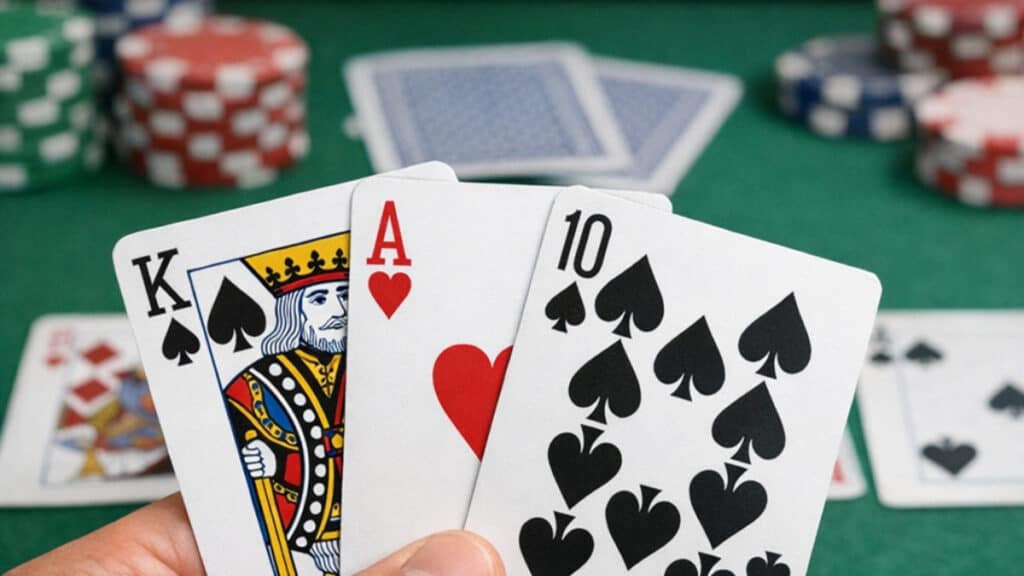
Pineapple Poker: Three-Card Texas Hold’em Variant
Pineapple poker transforms traditional Texas Hold’em by dealing three hole cards instead of two, requiring players to discard one card at specific points depending on the variant. This structural change increases average starting-hand strength by approximately 17–22%, based on the additional two-card combinations created when selecting the best two cards from three, significantly shifting optimal starting hand ranges and postflop strategy.
Understanding pineapple poker rules and mastering discard timing sets players who leverage additional information apart from those who mismanage three-card decision points.
What Is Pineapple Poker
Pineapple poker is a family of Hold’em variants in which players receive three hole cards rather than the standard two. The defining characteristic involves mandatory card discarding, with timing variations creating three distinct games: standard Pineapple (discard preflop), Crazy Pineapple (discard after flop), and Lazy Pineapple (no discard, play best two).
Pineapple Card Game Origins
The pineapple card game emerged in home games during the 1980s as players sought Hold’em variations with increasing action. According to poker historian David Sklansky’s “The Theory of Poker” (1987), Pineapple variants gained popularity in California cardrooms before spreading to online platforms in the early 2000s.
Pineapple vs Traditional Hold’em
Pineapple poker differs from standard Texas Hold’em through increased starting hand strength (three cards provide multiple combinations), higher action levels (more players hit strong hands), added strategic complexity (discard decisions), and improved implied odds for drawing hands.
Hold’em vs Pineapple: Hand Frequency Comparison
| Hand / Draw Type | Texas Hold’em | Pineapple Poker |
|---|---|---|
| Flopped top pair or better | ~32% | ~41% |
| Open-ended straight draw | ~10% | ~16% |
| Flush draw on the flop | ~11% | ~14% |
| Two pair or better by the river | ~18% | ~26% |
Three-card selection dramatically increases the frequencies of made hands and draws. Players should expect opponents to arrive at showdown with materially stronger holdings than in standard Hold’em.
Pineapple Poker Rules
Pineapple poker rules vary by format, but all versions share a core Hold’em structure with three-card modifications, creating distinct strategic considerations.
Standard Pineapple Rules
Standard Pineapple (also called Pineapple Hold’em) follows this sequence: each player receives three hole cards, preflop betting occurs, each player discards one card before the flop, then standard Hold’em structure continues through flop, turn, and river betting rounds. Showdown uses the best five-card hand, using the remaining two hole cards and the community cards.
The critical distinction occurs preflop, when players must discard before seeing the flop, creating purely strategic decisions without additional information.
Crazy Pineapple Rules
Crazy Pineapple poker rules shift discard timing: players receive three cards; preflop betting occurs; the flop is revealed; players discard one card after seeing the flop; then standard betting rounds continue through the turn and river. This format allows players to see the flop with all three cards, providing significantly more information for discard decisions.
Crazy Pineapple increases strategic depth by delaying discard decisions until after the flop, forcing players to evaluate three two-card combinations instead of one, effectively tripling decision complexity compared to standard Pineapple.
Lazy Pineapple (Tahoe) Rules
Lazy Pineapple eliminates discard requirements. Players receive three hole cards, play through standard betting rounds (preflop, flop, turn, river), and at showdown select their best two hole cards to combine with community cards. This variant maximizes hand strength.
The no-discard format maximizes action and hand strength, making Lazy Pineapple popular in home games and on the best online poker sites, which feature mixed-game rotations across all three Pineapple variants.
How to Play Pineapple Poker
How to play pineapple poker requires understanding hand selection, discard strategy, and adjusted postflop play that accounts for increases in opponent hand strength.
Starting Hand Selection
Pineapple starting hands require a different evaluation than Hold’em. Premium holdings include three Broadway cards (KQJ, QJT), pocket pairs with connectors (JJT, 99T), suited ace combinations (As Ks Js), and double-suited hands (Ks Qs 8d 7d). Marginal holdings include single high cards with disconnected lows, unsuited gaps, and weak pairs without support.
Optimal Pineapple starting ranges should expand approximately 20–25% wider than Hold’em due to discard flexibility, a conclusion consistent with range-expansion principles outlined in Bill Chen’s The Mathematics of Poker (2006).
Standard Pineapple Discard Strategy
In standard Pineapple, discarding occurs preflop without additional information. With pocket pairs, discard the lowest unrelated card, keeping the pair plus the highest kicker. With drawing hands, hold the highest flush or straight potential. With multiple combinations, evaluate relative strength and retain the best two-card holding.
Crazy Pineapple Discard Strategy
Crazy Pineapple provides flop information before discarding. After flopping pairs, discard unrelated cards, keeping pair plus best kicker (exception: keep flush/straight draws over weak kickers when drawing to nuts). After flopping two pair or trips, keep those combinations and the best kicker(s) while evaluating full-house potential.
With drawing hands, keep the strongest draw combinations considering implied odds.
Real Hand Example: Discard Decision EV Shift
In a $1/$2 Crazy Pineapple cash game, a player holds Ah Kd Qh on a Jh 9h 3c flop.
Possible keeps:
- Ah Kd → top pair, weak backdoor
- Ah Qh → nut flush draw + gutshot
- Kd Qh → second pair + draw
Equity simulations show Ah Qh retains the highest turn-and-river equity despite lacking a made hand. Discarding Kd maximizes long-term value, even though it sacrifices immediate top-pair strength.
Pineapple Texas Hold’em Strategy
Pineapple Texas Hold’em strategy requires adjusting traditional Hold’em concepts to account for increased hand strength across the player pool.
Hand Reading Adjustments
In pineapple Hold’em, opponents reach showdown with significantly stronger holdings than standard Hold’em. Key adjustments include:
Flop Texture Evaluation: Connected boards (JT9, 876) become more dangerous as players hold multiple straight combinations. Solver-based analyses from modern training platforms show that on coordinated boards (JT9, 876), straight-completion probability increases by roughly 35–40% compared with traditional Hold’em.
Flush Draw Frequency: Players see three cards, increasing the likelihood of suited holdings. Flush draws appear approximately 20–30% more frequently than in Hold’em due to three-card starting hands increasing the probability of suited combinations.
Made Hand Strength: Top pair weak kicker loses significant value as opponents frequently hold better kickers from three-card selection.
Position and Aggression
Position value amplifies in Pineapple due to information advantages. Early position (UTG, UTG+1) requires tighter play, with a focus on premium combinations. Middle position (MP, HJ) expands to suited connectors and Broadway holdings. Late position (CO, BTN) steals aggressively. Blinds defend wider since three cards provide more marginal defending hands post-discard.
Pot Control and Hand Value
Pineapple rewards cautious play with marginal made hands:
- Top pair: Prefer check-calling over thin value betting
- Overpairs: Bet for value but fold against heavy aggression
- Draws: Bet aggressively to maximize fold equity
- Premium hands (sets, straights): Build pots aggressively, as opponents often hold strong second-best hands
Crazy Pineapple Advanced Strategy
Crazy Pineapple introduces post-flop discard decisions, creating advanced strategic considerations beyond standard formats.
Flop Discard Optimization
An optimal discard strategy involves calculating equity for all three two-card combinations. On dry boards (Kh 7c 2d), keep high-card combinations over speculative holdings. On wet boards (Jh Th 8c), retain draw potential over weak made hands. On paired boards (QQ7), keep boats draws and trips over top-kicker considerations.
Deceptive Discard Patterns
Advanced players use discard timing to manipulate opponent hand reading. Fast discarding suggests straightforward decisions, while slow discarding indicates marginal choices. In live games, discard timing can convey meaningful information, as Zachary Elwood explores in Reading Poker Tells (2012), though online play eliminates physical cues.
Range Construction
Building balanced ranges requires understanding opponent discard patterns and board interactions. On action flops, polarize toward nutted hands and draws. On dry flops, merge ranges including medium-strength made hands, draws, and premium holdings.
Blockchain enthusiasts seeking transparent platforms often investigate crypto poker sites that use provably fair Pineapple variants.
Common Pineapple Poker Mistakes
Recognizing frequent Pineapple errors helps players avoid costly strategic leaks specific to three-card formats.
Overvaluing Weak Made Hands
The most common mistake is overvaluing a top pair with a weak kicker. In Pineapple, the top pair without a premium kicker frequently loses. Implement wider folding ranges with marginal made hands facing aggression.
Suboptimal Discard Decisions
Players frequently discard based on immediate strength without considering turn/river potential. Example: Holding Ah Kc Qh on Kd 9h 5h, players often discard Qh to keep AK. Optimal discard: Kc, keeping Ah Qh for nut flush draw despite sacrificing current top pair.
Applying Hold’em Ranges Directly
Using standard Hold’em ranges without adjustment creates errors. Pineapple requires 20-25% wider opening ranges to discard, improving effective strength. Expand starting selection while tightening showdown ranges.
Misunderstanding Hand Frequencies
Players expect Hold’em frequencies without adjusting for Pineapple’s increased connectivity. Sets, straights, and flushes occur materially more often than in Hold’em because players see three cards and retain the strongest two-card combination, improving connectivity and draw completion rates. Adjust hand reading to give opponents credit for strong holdings more liberally.
Pineapple Poker Variations
Beyond standard, Crazy, and Lazy formats, several Pineapple variants offer unique strategic challenges.
Super Hold’em (Irish Poker)
Super Hold’em combines Omaha and Pineapple mechanics. Players receive four hole cards, play preflop betting, see the flop, then discard two cards (keeping two for showdown). Remaining betting proceeds normally.
Double Board and High-Low Variants
Double Board Pineapple uses two separate boards that run simultaneously. Players use the same hole cards for both boards, and the pot is split between the best hands on each board. High-Low Pineapple splits pots between the best high hand and qualifying low hand (eight-or-better), rewarding hands with low potential and wheel draws (A2345).
Aspiring professionals seeking comprehensive knowledge often explore educational resources, such as poker lesson guides, that cover strategic fundamentals across poker variants, including Pineapple.
Adapting to Three-Card Action
Pineapple poker adds strategic depth with three-card starting hands and mandatory discards. Success depends on accurate hand-strength evaluation, optimal discard timing, and disciplined pot control in an environment where opponents consistently hold stronger combinations.
Mastering Pineapple formats develops transferable skills for mixed games and enhances postflop decision-making beyond traditional Hold’em.
Please play responsibly. 21+, T&Cs apply.