

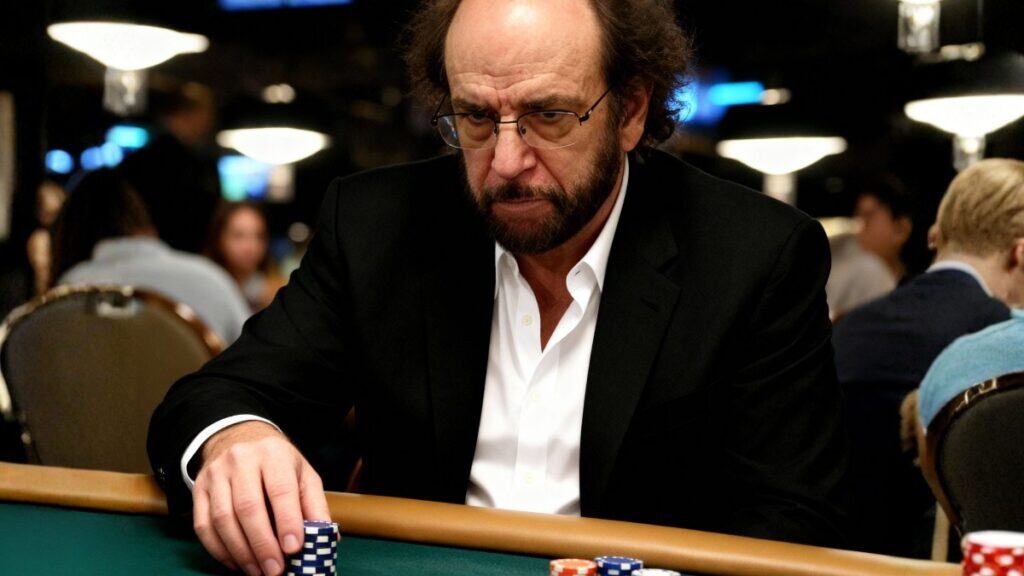
Mike Caro: How One Man Changed Poker
Mike Caro helped push poker away from gut instinct and toward testable ideas.
His odds tables in Doyle Brunson’s Super/System, his Book of Poker Tells, and his early software projects like Orac and Poker Probe showed that live reads and math could be studied instead of guessed at.
The path from bar-room stories to today’s solver culture runs partly through his habit of turning every claim about poker into something that could be charted, simulated, or challenged.
The Early History of Mike Caro
Michael Caro was born in 1944 in Joplin, Missouri, and he gravitated toward games early. That matters because his later poker work didn’t treat playing as pure instinct; it treated decisions as repeatable spots that could be explained, charted, and argued.
When he moved into poker writing and consulting, the tone stayed consistent: claims should stand up to pressure, and “I knew it” stories should not.
His writing treats poker statements as hypotheses, then pressures them with repeat spots and documented outcomes instead of table stories. As Caro puts it, “If something seems inequitable in one hand but gives no long-run advantage, we might not need a rule.”
Super/System and the Math Leap: Charts and Odds
Poker people tend to sort influence into two buckets: ideas that change how hands get played, and tools that change how hands get studied.
In 1978, Caro contributed a large set of odds tables to Doyle Brunson’s Super/System. On his Poker1 site, Caro’s own odds-table index labels these as the “50 often-cited tables,” originally created in the early 1970s and included in the first edition.
Brunson’s Super/System credits Caro with both the draw-poker chapter and those tables, and later bios and reference pieces mirror that arc: early 1970s hand-calculation work, a 1978 flagship strategy book, then wider use of precomputed probabilities in casino consulting and consumer study tools.
Suddenly, “I think you’re drawing thin” had numbers behind it, and the room talk started shifting. That shift shows up in modern poker rooms where players think in ranges, prices, and expected outcomes, even without formal jargon.
Live players still lean on quick math because it travels across formats. Facing a half-pot bet, a call needs about 33% equity to break even on price alone. Pot-odds framing like that helps separate a tough fold from a bad fold, then pairs well with what opponents tend to do in similar spots. Charts did not invent the math; they normalized using it mid-hand.
Caro’s Book of Poker Tells
Caro’s Book of Poker Tells, first published in 1984 and expanded into a 320-page Cardoza title, took something players sensed and tried to pin it down. The focus is physical behavior, timing, and speech patterns that line up with strength or weakness, built around ideas such as “weak means strong” and “strong means weak.”
The book pushes readers to look for clusters of behavior tied to a baseline, compare that with the betting line, and track what was seen before showdown instead of letting memory rewrite hands later. One photo sequence shows a player who sighs, shrugs, and shoves chips in with what turns out to be a strong hand; the performance of reluctance invites action, and the real signal only shows up once the cards are revealed often enough.
A hypothetical worked spot might have a pot of 300 where an opponent bets 150 on the turn, so the call needs about 33% equity on price alone. A solid default plan checks if your range estimate clears that line; if it does, calling makes sense, and if it does not, folding does.
A Caro-style read then comes in as a small adjustment, such as nudging a close fold toward a call when a baseline-tight opponent suddenly acts “weak means strong” in a way you have seen pay off in previous showdowns.
Table: Mike Caro’s Major Works and Tools
The easiest way to see Mike Caro’s reach is to line up his projects and look at what players actually did with them over time.
| Year | Title / Tool | Type | What it did | Where it shows up now |
|---|---|---|---|---|
| 1978 | Super/System contribution | Book chapter | Put odds and decision tables into mainstream poker reading | Pot-odds talk in live cash games and tournaments |
| 1984 | Orac | Software demo | Modeled poker decisions in a way pros hadn’t seen from a computer | Training bots and early AI study tools |
| 1987 | Mike Caro’s Poker Engine | Software | Calculated hand matchups across large ranges | Equity calculators used in study sessions |
| 1990 | Poker Probe | Consumer software (DOS-based home program) | Gave players hand analysis at home | Modern hand evaluators and apps |
Each entry reflects a similar idea: stop guessing, test the claim, then see if it survives repetition. Poker Probe let players run thousands of simulated deals at home in hot-and-cold style to see how specific hands or ranges performed instead of estimating rough odds, and it became one of the first widely cited poker simulators.
That same encode-simulate-review habit now sits inside modern equity calculators, solvers, and training apps, which push those questions much deeper than a home machine from the 1980s could manage.
Orac and Early “AI poker”
Orac, a poker-playing program running on an Apple II Plus, made its public debut at the World Series of Poker in 1984. Caro spent years building it and used bar-coded cards plus a scanner so the machine could “see” hole cards and board cards without a human interpreter.
Exhibition matches on the WSOP stage at Binion’s Horseshoe, rather than in bracelet events, put Orac across the table from players such as Tom McEvoy, Doyle Brunson, and Bob Stupak, documented in letters, media coverage, and later retrospectives.
Those exhibitions mattered because they reframed what counted as serious poker work. If a program could manage stack sizes, hand classes, and betting sequences well enough to be taken seriously in public matches, then hand histories and equity math moved from side projects into core study tools.
Orac did not solve games or spit out perfect strategies; it ran structured decision rules and let observers see how those rules held up across repeated trials. That was enough to normalize the idea that poker decisions could be encoded, tested, and refined in software instead of living only in private notebooks.
The Caro Mindset in Modern Poker
Online poker tables change the “tells” conversation because most physical signals never reach the opponent. Patterns still exist, yet they show up in timing, sizing, and repetition across many hands. A fast snap-check can mean comfort with a spot; a long pause can mean multi-tabling, a tough decision, or a planned delay to look balanced.
Keep these tips in mind when trying to understand tells:
- Start with the action line, then layer in behavior as a small weight, not the full answer.
- Track repeats over many hands; one strange motion can be noise.
- Separate nerves from deception; both can look identical in practice.
- Watch for mismatches: confident betting paired with hesitant motion, or the reverse.
- Respect environment effects like camera awareness, table talk, and fatigue.
- Write down what was seen before the showdown, then check it against revealed cards to keep memory honest.
What Changes and What Still Holds Up
Some classic live tells degrade fast in modern rooms because players study the same material, watch streams, and practice reverse-tell behavior on purpose. Camera awareness and social media clips also change posture and speech at the table, which makes baseline reads harder to build in a single session.
All of that unfolds in a market that, according to the American Gaming Association’s State of the States 2025 report, generated about 72 billion USD in U.S. commercial gaming revenue in 2024. That figure was up about 7.5 percent year over year as regulated online sports betting, iGaming, and online poker make real-money play more popular than ever.
Those limits create their own behaviors: players protect time for big turns and rivers, then simplify early streets. Reads move from posture to pace, from speech to repeatable betting lines.
The durable part of the Caro approach is methodological: start with action, sizing, and position, then treat behavior as a secondary input that must match the line or get discounted.
What We Can Learn From Mike Caro
Mike Caro’s influence holds up because it resists shortcuts.
He argued that poker decisions deserve evidence, not legends, and that human behavior can be studied without pretending it never lies. That stance fits a faster, more technical game where stories travel quickly and errors repeat just as fast.
Strip away the nickname, and what’s left is a habit of thinking that still travels well across tables, formats, and decades.
If gambling ever stops feeling controlled, help is available. Call or text 1-800-GAMBLER for confidential support.